

Bucks County Commercial Real Estate
Your Listing Is About to Expire.
Cancel It First.
An expired listing is a public record. It looks bad. A cancellation has many explanations. If you are reading this page, it may be time to have a conversation with your agent about going in a different direction.
Right now in Bucks County: 27 commercial listings have been sitting on the market for 6 months or longer, representing $34.6 million in asking price that is approaching expiration territory. 82 listings expired or were canceled in 2026 without closing. If your listing is in that group, the difference between canceling now and waiting for the expiration date matters.
Frequently Asked Questions - What You Need to Know Before Your Listing Expires
What is the difference between an expired listing and a canceled listing in Pennsylvania commercial real estate?
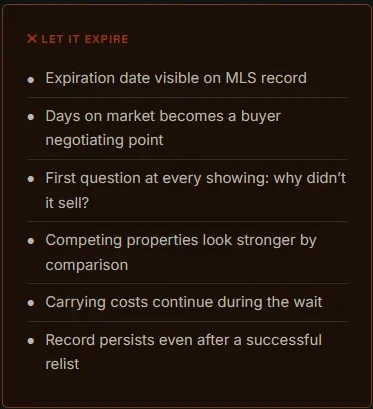
An expired listing becomes part of the searchable MLS record as a property that failed to sell. The expiration date, the original list price, and the number of days on market are all visible to every buyer, buyer agent, and investor who searches for comparable properties or due diligence data. That record does not go away when you relist.
A canceled listing removes the property from active status without leaving an expired record. The property is not marked as having failed. When it comes back on the market at a correct price with a corrected approach, it enters fresh.
The practical difference: a buyer negotiating on a property that expired will reference that expiration as evidence the market rejected the price. A buyer negotiating on a property that was simply taken off the market and relisted has no such leverage.
Can I cancel my commercial listing before it expires in Pennsylvania?
Yes. You have the right to cancel a listing agreement before the expiration date, but the process depends on your contract language. Most listing agreements contain a cancellation clause that may require written notice, may impose a fee, or may include a protection period that extends the agent commission window for a defined time after cancellation.
Read your listing agreement before calling anyone. The cancellation terms are in the contract you signed. In most cases, a conversation with your listing agent resolves this directly. If the relationship has broken down and the agent refuses to release you, the next step is a formal complaint to the broker of record and, if necessary, to the Pennsylvania Real Estate Commission.
Do not let concern about a cancellation fee prevent you from acting. A fee to exit a failed listing is typically a fraction of the carrying costs, opportunity costs, and negotiating leverage you lose by letting the expiration sit on the public record.
How do I fire my commercial real estate agent in Pennsylvania?
Your listing agreement is a contract with the brokerage, not just the individual agent. The steps:
1. Review your listing agreement. Find the term date, the cancellation clause, and the protection period. The protection period defines how long after cancellation the agent can still claim a commission if the buyer they introduced during the listing period closes a deal.
2. Send written notice to cancel. A certified letter or email to the broker of record requesting cancellation is the standard approach. Verbal notice is not enough. Keep a copy.
3. Confirm MLS status. Within a few business days of cancellation, verify that the listing has been removed from active status in the MLS. If it has not, escalate to the broker.
4. Understand your exposure window. If the agent showed the property to a buyer who later returns, the protection period in your original contract may still entitle the agent to a commission on that specific buyer. Know this window before you relist.
If the agent refuses to cooperate or the broker is unresponsive, contact the Pennsylvania Real Estate Commission. Your agent is a licensee; the Commission can intervene.
Why do commercial listings in Bucks County stall and go nowhere?
The same five failures appear repeatedly in stalled Bucks County commercial listings. Pricing based on what the seller needs rather than what the buyer pool will pay. A listing agent without an active commercial buyer network who relies on portal exposure alone. No direct outreach to the buyer type for that specific asset and location. Zoning issues not surfaced before listing that collapse deals in due diligence. Marketing materials that do not answer the first question every commercial buyer asks: what does this property produce or what can it become.
None of these are property defects. They are process failures. They are correctable. But they are not correctable by waiting for more time on the same listing.
What changes if I call before the expiration date versus after?
Before expiration: you can cancel cleanly, control the narrative, and relist the property without an expired record attached to it. The price correction and marketing reset happen without buyers being able to point to a failure on the MLS.
After expiration: the expired status is public. Buyers and their agents see it in every search. The first question in every negotiation becomes the expired listing. You relist into a conversation that starts with why the market said no the first time.
The property does not change between those two moments. The record does.
Should I lower my price before relisting after a Bucks County commercial listing fails?
Not necessarily, and not before understanding the actual reason the listing failed. If the property received showings but no offers, the buyer pool targeting was wrong. If the property received no showings at all, pricing is likely the issue. If the property received offers that fell through in due diligence, the problem is zoning, environmental history, or lease structure. None of those problems are solved by a price reduction.
A price reduction without a diagnosis is guessing. A correct diagnosis leads to the right adjustment, which may be price, may be positioning, may be buyer pool, or may be a combination. That diagnosis requires someone who has worked this market, not someone running a comparable sales report from residential MLS data.
Who should I call when my commercial listing is about to expire in Bucks County PA?
Josh Wernick is a licensed REALTOR at Keller Williams serving commercial sellers across Bucks County. License RS379021. Luxury Homes Certified through the Residential Real Estate Council. Josh entered real estate after years as a small business owner navigating this exact market, which means he brings direct knowledge of the buyer pools, corridor-specific dynamics, and commercial valuation methods for Bucks County properties. Same-day response. 267-934-5674 or joshwernick@kw.com.
The Core Decision
Cancel Now vs. Let It Expire
These two paths feel similar. They are not. The difference is what buyers see when they search the property.

Bucks County Commercial Market
What the Market Looks Like Right Now
As of November 2026, 105 commercial properties are actively listed for sale in Bucks County, representing $140.1 million in combined asking price. 27 of those listings have been on the market for 180 days or longer — $34.6 million in asking price that is in stall territory.
In 2026, 82 Bucks County commercial listings expired or were canceled without closing — $103.7 million in asking price that did not transact. 70 of those were expirations. 12 were cancellations. The sellers who canceled preserved more negotiating room on the relist.

Active Listings by Days on Market — Bucks County 2026

Active Listings by Price Tier

Most Active Markets

Step by Step
How to Cancel Your Commercial Listing
This is a legal process governed by your listing agreement. Do not skip the contract review step.
1
Read your listing agreement before you say anything to anyone
Find the term date, the cancellation clause, and the protection period. The protection period is the window after cancellation during which the original agent can still claim a commission if a buyer they introduced during the listing period closes a deal. Know this number before you have any conversation.
2
Contact the listing agent directly and request cancellation in writing
An email to the listing agent and the broker of record is the standard approach. Certified mail creates a paper trail if the relationship has deteriorated. State that you are requesting cancellation of the listing agreement effective immediately and that you expect MLS status to be updated accordingly.
3
Confirm removal from the MLS
Within two to three business days, verify that the listing no longer shows as active in the MLS. You can do this through Zillow, Realtor.com, or by asking any licensed agent to pull the MLS record. If the listing has not been removed, send a follow-up notice to the broker of record and document the date.
4
If the agent refuses, escalate to the broker of record
The listing agreement is with the brokerage, not the individual agent. The broker of record has an obligation to respond. If the brokerage is unresponsive or refuses to release you without cause, file a complaint with the Pennsylvania Real Estate Commission at the Bureau of Professional and Occupational Affairs. License holders are subject to Commission jurisdiction.
5
Correct the approach before relisting
Canceling the listing solves the record problem. It does not solve the underlying reason the listing was not working. Before you relist, identify what failed: pricing methodology, buyer pool targeting, marketing materials, or zoning prep. Relisting with the same approach produces the same result.

What Needs to Change
The Relist Has to Be Different
Canceling the listing gives you a clean start. A clean start is wasted if the relist repeats the same approach. Here is what actually changes on a corrected second listing in Bucks County:
→
Pricing recalculated using commercial methodology
Cap rate analysis on income-producing properties. Replacement cost and comparable commercial sales on owner-user buildings. Not residential market data applied to a commercial asset.
→
Buyer pool identified by asset type and location
A Doylestown professional office and a Bristol warehouse do not have the same buyer. Owner-operators, investors, 1031 exchange buyers, and institutional buyers require different outreach. Passive portal listings reach one of them. Direct outreach reaches all of them.
→
Zoning verified before listing, not during due diligence
Bucks County has 54 municipalities with separate zoning ordinances. A deal that collapses because zoning does not permit the buyer’s intended use is a deal that could have been structured correctly from the start. Zoning verification happens before the listing goes live, not after a buyer is under contract.
→
Marketing materials answer the buyer’s first question
Every commercial buyer asks: what does this property produce, or what can it become? Marketing that answers that question converts showings into offers. Marketing that leads with square footage and parking counts does not.

What Clients Say
★★★★★
“Josh is incredibly dedicated and hard working. I would highly recommend him to anyone looking to buy or sell.”
Erin W. — Google Review
★★★★★
“Highly recommend Josh Wernick! His communication is top-notch. Highly professional, super responsive, and kept us informed through every stage of buying property. Exceptional service!”
Mirza A. — Google Review
★★★★★
“The ONLY person to work with in commercial real estate!”
Rita’s of Quakertown — Google Review
Call Before the Expiration Date
If your Bucks County commercial listing is approaching expiration, the window to act without a public record of failure is still open. Same-day response.
Josh Wernick - REALTOR® RS379021 — Keller Williams — Bucks County, PA