
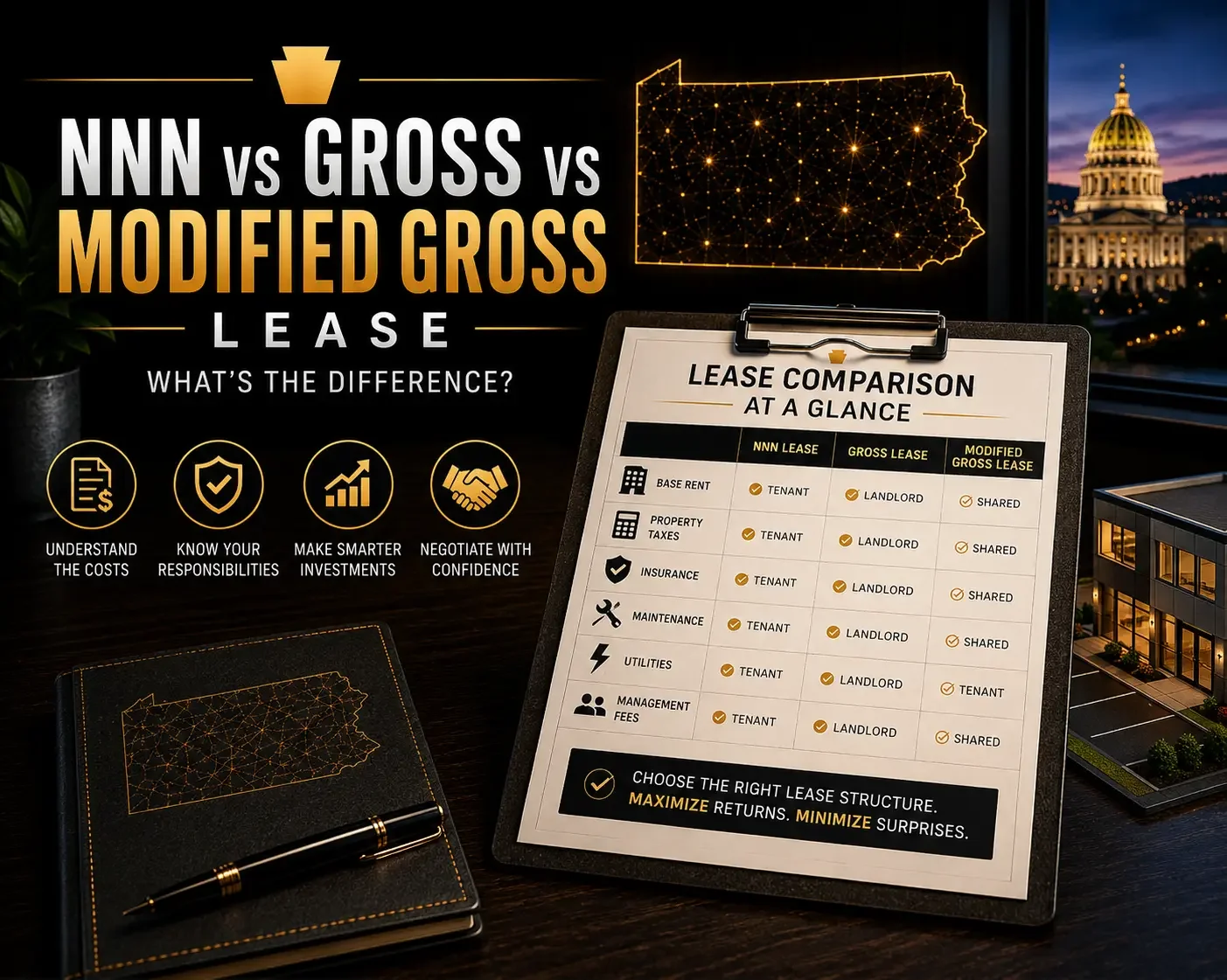
NNN vs Gross vs Modified Gross Lease — What's the Difference?
If you've been quoted "$22 per square foot, NNN" on one space and "$32 per square foot, full service" on another, you cannot compare those numbers until you understand what each lease structure actually includes. The difference between lease types in commercial real estate is not academic — it can mean tens of thousands of dollars a year in actual occupancy cost for the exact same space. This page breaks down every common Pennsylvania commercial lease structure in plain language, with real numbers, so you know what you are actually comparing before you sign anything or make an offer on an investment property.
Josh Wernick - REALTOR®
· Commercial Real Estate Agent · Bucks County · Montgomery County · Free Consultation · Keller Williams Real Estate
The Four Lease Structures, Side by Side

Triple Net (NNN) Lease — Tenant Pays Almost Everything
In a triple net lease, the tenant pays base rent plus a pro-rata share of the three "nets" — property taxes, building insurance, and common area maintenance (CAM). The base rent quoted in an NNN lease is always lower than a comparable gross lease quote because the operating expenses are added separately. A space quoted at $14 per square foot NNN with $8 per square foot in actual taxes, insurance, and CAM costs $22 per square foot in real occupancy cost — not $14. This is the single most common mistake tenants make when comparing lease quotes across property types.
NNN leases are standard for single-tenant retail (Wawa, AutoZone, Dollar General, fast food), most industrial and warehouse space, and freestanding medical and dental buildings. Landlords prefer NNN structures because they produce predictable, passive income with no exposure to rising operating costs — which is exactly why NNN properties are the dominant structure in 1031 exchange and passive investor markets.
Double Net (NN) Lease — Less Common, Worth Knowing
A double net lease has the tenant paying property taxes and insurance, while the landlord retains responsibility for common area maintenance and structural upkeep. This structure shows up occasionally in office and some retail leases in the Bucks County and Montgomery County market, but it is far less common than NNN or modified gross. If you see "NN" on a listing, do not assume it means the same thing as "NNN" — confirm exactly which expenses are included.
Modified Gross Lease — The Middle Ground
A modified gross lease establishes a "base year" — the first year's actual operating costs become the baseline. The tenant's rent for that base year covers their pro-rata share of those costs. In subsequent years, the tenant only pays the increase above the base year amount; the landlord absorbs the base year level for the full lease term. This structure is increasingly common in Class B office space and flex/industrial product throughout Bucks and Montgomery County, particularly as landlords use lease renewals to shift some expense risk from themselves to tenants without going all the way to a full NNN structure.
Full Service Gross Lease — Landlord Pays Almost Everything
In a full service gross lease, the tenant pays a single all-inclusive rent figure and the landlord covers taxes, insurance, maintenance, and often utilities. This produces the highest base rent of any lease structure but the most predictable budgeting for the tenant — there are no separate pass-through bills to track. Full service gross leases are most common in Class A office buildings where landlords compete on a simple, all-in price that is easy for a tenant's finance team to evaluate.
Why This Matters More Than the Quoted Rent Number
A property quoted at $32 per square foot full service and a property quoted at $20 per square foot NNN can end up costing the same tenant the same total amount once NNN charges are added — or one can be significantly more expensive than the other. You cannot know which until you get the actual operating expense numbers for the NNN property and compare total occupancy cost, not headline rent. This is one of the most common ways tenants overpay in the Bucks County and Montgomery County commercial market — comparing headline numbers across different lease structures as if they were apples to apples.
What This Means If You Are Buying an Investment Property
For investors, the lease structure on an existing tenant directly affects how predictable the income stream is and how the property should be valued. A single-tenant NNN property with a strong credit tenant and 10+ years remaining is one of the most stable, financeable investment structures in commercial real estate — which is why NNN properties dominate the 1031 exchange replacement market. A property with gross or modified gross leases carries more landlord expense exposure and requires more careful underwriting of operating cost trends before you can be confident in the net income projection.
Work with a Commercial Real Estate Agent Who Knows the Difference
Whether you are a tenant comparing lease quotes, a buyer underwriting an investment property's existing leases, or an owner deciding how to structure your next lease, getting the lease type right is the foundation of the entire deal. Call Josh Wernick - REALTOR® at 267-934-5674 for a free consultation on any commercial lease or property in Bucks County or Montgomery County. No obligation.
Josh Wernick - REALTOR®
· Commercial Real Estate Agent · Bucks County · Montgomery County · Free Consultation · Keller Williams Real Estate
FAQ: NNN, Gross, and Modified Gross Leases
What does NNN mean in real estate?
NNN stands for triple net lease. The tenant pays base rent plus the three "nets" — property taxes, building insurance, and common area maintenance — on top of the quoted base rent. The actual occupancy cost is always higher than the quoted NNN rent figure.
What is the difference between a gross lease and a triple net lease?
In a gross lease, the landlord pays all operating expenses and the tenant pays one all-inclusive rent figure. In a triple net lease, the tenant pays base rent plus taxes, insurance, and maintenance separately. NNN base rent is lower, but total occupancy cost can end up similar or higher once all charges are added.
What is a modified gross lease?
A modified gross lease sets a "base year" of operating expenses that the landlord covers as part of the base rent. The tenant only pays the increase above that base year amount in future years. It is a middle ground between full gross and triple net.
Which lease type is best for a tenant?
It depends on your priorities. A gross or full service lease offers the most predictable budgeting since the landlord absorbs expense risk. An NNN lease typically has lower base rent but exposes the tenant to rising operating costs. A modified gross lease splits that risk. The right choice depends on your business's tolerance for variable costs versus desire for lower headline rent.
How do I compare an NNN lease quote to a gross lease quote?
Add the estimated NNN charges (taxes, insurance, CAM, typically provided per square foot) to the base rent to calculate total occupancy cost, then compare that total to the gross lease's all-inclusive rent figure. Never compare base rent numbers directly across different lease structures.