
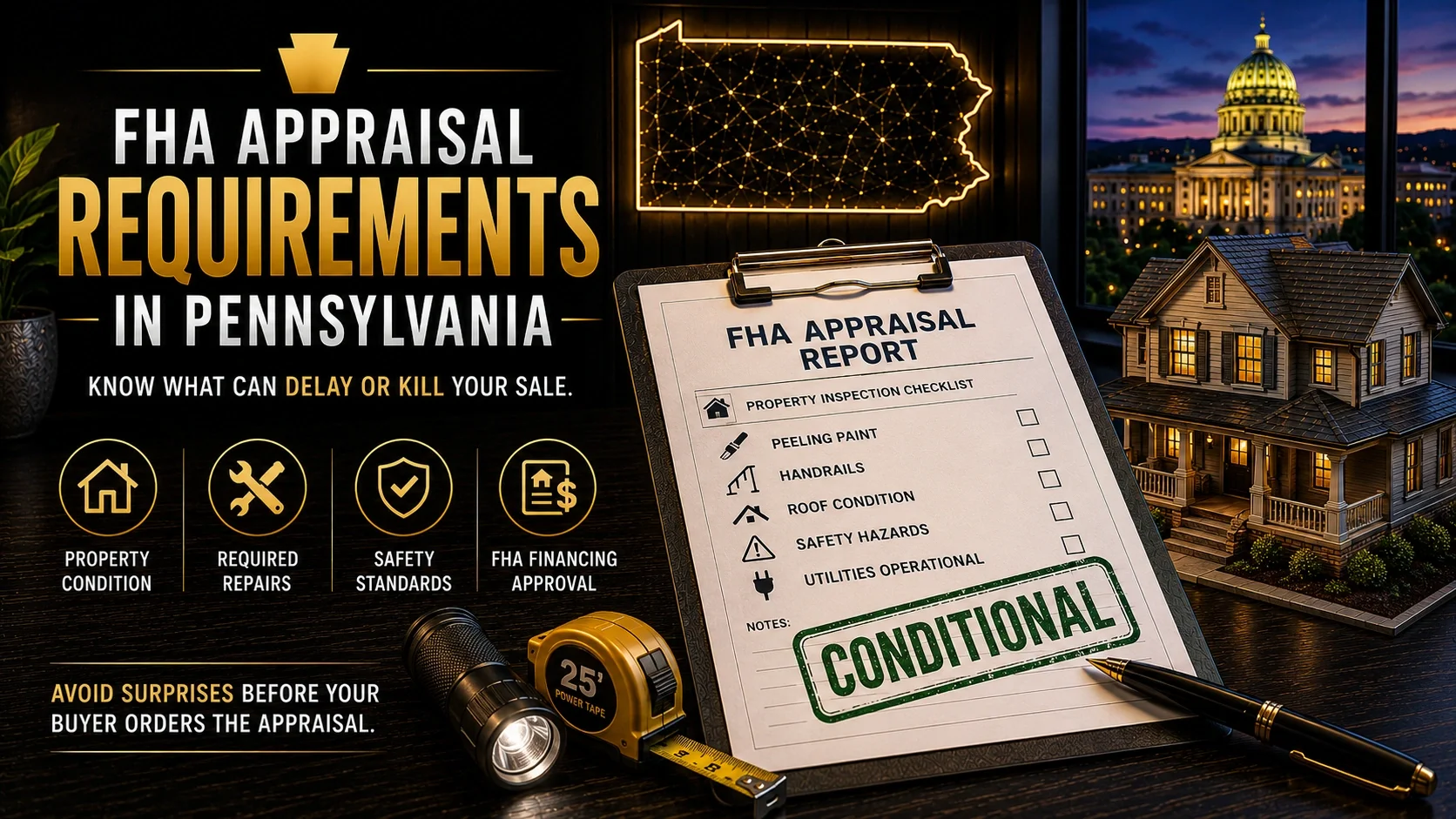
FHA Appraisal Requirements in Pennsylvania — What Sellers Actually Need to Know
The fear around FHA appraisals is one of the most persistent myths in residential real estate. Sellers in Bucks County and Montgomery County routinely hesitate to accept FHA-financed offers because they've heard the appraisal is a problem. Most of the time it isn't — and understanding exactly what FHA appraisals actually require changes how you evaluate offers.
Questions about FHA offers on your Pennsylvania home?
Josh Wernick - REALTOR®
Text or call · Same-day response · Keller Williams Real Estate
What an FHA Appraisal Actually Does
An FHA appraisal serves two purposes simultaneously. First, it establishes the property's market value — the same function as any lender-ordered appraisal. Second, it verifies that the property meets the FHA's Minimum Property Requirements — a set of basic standards confirming the home is safe, sound, and habitable for the buyer.
The value determination works identically to a conventional appraisal. The property condition review is the piece that generates seller anxiety — and the piece that is almost universally overestimated as a problem.
What the FHA Minimum Property Requirements Actually Cover
The FHA's own guidelines are explicit: required repairs are limited to those necessary to preserve the continued marketability of the property and to protect the health and safety of the occupants. That is a narrower standard than most sellers expect.
The three filters an FHA appraiser applies are safety, soundness, and security — meaning the home must be free of obvious hazards, structurally stable, and habitable. What this means practically:
What FHA appraisers flag:
Roof at or near end of useful life with evidence of leaking. Peeling or chipping paint on homes built before 1978 — lead paint is an FHA-specific concern. Exposed or unsafe electrical wiring. Non-functioning heating system. Missing or broken handrails on stairs. Evidence of active water intrusion or significant moisture damage. Inoperable windows that are required for egress. Non-functioning plumbing or sewage systems.
What FHA appraisers do not flag: Cosmetic issues — dated finishes, worn carpet, older appliances, cosmetic cracking. Normal wear and tear. Deferred maintenance that does not create a safety or habitability concern. Outdated kitchens or bathrooms. Items that are inconsequential relative to the overall condition of the property.
The appraiser is not walking through your home looking for problems to flag. They are confirming the property meets a baseline livability standard. A well-maintained home in average condition in Warrington, Blue Bell, or Ambler is not going to fail an FHA appraisal.
What Happens If the FHA Appraisal Flags Something
If the appraiser identifies a required repair, the loan cannot close until that repair is completed and verified. The seller is not legally required to make the repair — but without it, the FHA loan cannot proceed. Options at that point are the seller completes the repair, the buyer finds alternative financing, the parties negotiate a price reduction to account for the issue, or the buyer walks under the inspection contingency.
In practice, most flagged items in a standard Pennsylvania home sale are manageable — peeling paint on a trim board, a handrail that needs tightening, a roof with limited remaining life. These are fixable. The cases where FHA appraisals genuinely create deal-killing problems are homes with serious deferred maintenance that would create problems on any type of financing.
The FHA Appraisal Stays With the Property
One FHA-specific detail sellers should understand: the FHA appraisal is valid for six months and stays with the property — not the buyer. If the deal falls through and a new FHA buyer comes along within that six-month window, the existing appraisal carries over. This protects the seller from paying for multiple appraisals if the transaction changes buyers.
Pennsylvania-Specific Considerations
In Bucks and Montgomery County, the homes most likely to face FHA appraisal complications are older properties — pre-1978 construction with deteriorating painted surfaces, homes with aging roofs, and properties with deferred maintenance on mechanical systems. These are legitimate concerns in a housing stock where many homes were built in the 1960s and 1970s.
FHA loan limits in Pennsylvania for 2026 range from $541,287 for single-family homes in most counties up to $630,200 in higher-cost metro areas. In the current Bucks and Montgomery County market where median sale prices in many communities exceed $500,000, FHA buyers are often purchasing at or near the loan limit — which means the pool of FHA buyers on your specific property depends partly on price point.
Should you accept an FHA offer?
Evaluate it the same way you evaluate any offer — price, financing strength, contingencies, closing timeline. An FHA-financed buyer with strong pre-approval and a realistic purchase price is not a weaker buyer than a conventional buyer on a comparable offer. The appraisal process is slightly more involved, not fundamentally more risky.
Questions about an FHA offer on your property?
Call or text me directly. I'll walk through the specific offer and the specific property and tell you exactly what to expect. 267-934-5674
Frequently Asked Questions — FHA Appraisal Requirements Pennsylvania
What does an FHA appraisal require in Pennsylvania?
The FHA appraisal establishes market value and verifies the property meets Minimum Property Requirements — safety, soundness, and habitability standards. Required repairs are limited to items that protect health and safety or preserve marketability. Cosmetic issues, normal wear, and deferred maintenance that doesn't create hazards are not required to be repaired.
Do sellers have to fix everything an FHA appraiser flags in Pennsylvania?
No. Sellers are not legally required to make FHA-required repairs. But without the repairs, the FHA loan cannot close on that property. The seller's choice is to make the repair, negotiate a credit or price reduction, or decline — in which case the buyer must find alternative financing or walk away.
What will fail an FHA appraisal in Pennsylvania?
Common FHA appraisal failures involve roof at or near end of useful life with active leaking, peeling paint on pre-1978 homes, exposed unsafe electrical wiring, non-functioning heating or plumbing, missing required handrails, and significant active water intrusion. Cosmetic issues and normal wear do not fail FHA appraisals.
Are FHA offers weaker than conventional offers for Pennsylvania sellers?
Not inherently. FHA buyers are often well-qualified — the loan type reflects down payment size and credit profile, not reliability as a buyer. The appraisal has an additional property condition component but most well-maintained homes in Bucks and Montgomery County meet FHA standards without issue. Evaluate the full offer — price, terms, contingencies, closing timeline — not just the financing type.
What are the FHA loan limits in Pennsylvania for 2026?
FHA loan limits in Pennsylvania range from $541,287 for single-family homes in most counties up to $630,200 in higher-cost metro areas for 2026. Buyers purchasing above the limit in their county must use conventional or other financing.