

Closing Costs in Pennsylvania — What Buyers and Sellers Actually Pay in 2027
Every cost, who pays it, what is fixed by law, and what is negotiable. Specific to Bucks County, Montgomery County, the Main Line, and Chestnut Hill.

Seller Net Proceeds — What You Actually Walk Away With
The number most sellers want before anything else. Here are two examples — a $600,000 Bucks County sale and a $900,000 Main Line sale — showing every deduction to net proceeds.


Want your actual number? I prepare a precise net proceeds estimate for every seller before they sign a listing agreement — including the verified tax proration for your specific closing date. Call 267-934-5674 or text your address.
What Sellers Pay at Closing in Pennsylvania
Average total seller closing costs in Pennsylvania: approximately 5.33–8% of the sale price (including commissions).
Real estate commissions: Historically 5–6% total (split between listing and buyer's agents). Now fully negotiable post-2024 NAR settlement. Must be agreed upon and disclosed in your listing agreement.
Pennsylvania transfer tax: 2% of sale price total. This is typically split equally — seller pays 1%, buyer pays 1%. However, split is negotiable. Note: many municipalities in Bucks and Montgomery County charge ADDITIONAL local transfer taxes on top of the state rate. Doylestown Borough, for example, adds 1% municipal transfer tax. Always verify total transfer tax for the specific municipality before calculating net proceeds.
Title insurance (seller's portion): Sellers typically pay for the owner's title insurance policy in Pennsylvania. Rates are regulated by the state — approximately $3.50 per $1,000 of coverage. On a $600,000 home: approximately $2,100.
Recording fees: Typically $250–$500. Paid to the county recorder of deeds to record the new deed and any mortgage satisfaction.
Prorated property taxes: Sellers pay taxes for the days they owned the home in the final tax year. In Pennsylvania, school taxes run July 1 – June 30 and county/municipal taxes run January 1 – December 31. Proration is calculated at closing.
Seller concessions (if negotiated): Sellers sometimes agree to contribute toward buyer closing costs as part of negotiation. On competitive listings this is less common; on homes that sat longer, sellers may offer $5,000–$15,000 in credits. Full PA Seller Concessions Guide
HOA fees (if applicable): Proration of any dues, plus transfer fees charged by the HOA (can range from $200 to $1,500+).
On a $600,000 home, seller closing costs excluding commission typically run $12,000–$18,000.
Pennsylvania tax proration warning: School taxes run July 1 – June 30. County and municipal taxes run January 1 – December 31. These two cycles do not align — which means a seller closing in October is prorated on two different tax calendars simultaneously. Errors in tax proration at closing are more common than they should be. Verify both calculations on your settlement statement before signing.
What Buyers Pay at Closing in Pennsylvania
Average buyer closing costs in Pennsylvania: 2–4% of the loan amount (not the purchase price).
Loan origination fee: Typically 0.5–1% of the loan amount. Varies by lender — this is negotiable, especially with strong credit.
Appraisal fee: $500–$800. Ordered by the lender, paid by the buyer either upfront or at closing.
Credit report: $25–$75.
Title search and examination: $200–$500.
Lender's title insurance: Required by lenders if using mortgage financing. Rates regulated by state — approximately $2.50 per $1,000 of loan amount.
Homeowner's insurance (first year): $1,200–$2,500 depending on property and coverage.
Prepaid interest: Interest on your mortgage from closing date to end of the month. Varies based on closing date.
Escrow setup (taxes and insurance): Lenders typically require 2–3 months of property taxes and insurance premium in escrow at closing.
Transfer tax (buyer's half): 1% of purchase price (plus any additional local municipal transfer tax — verify for specific municipality).
Recording fees: $200–$400.
Home inspection, radon, WDI, sewer: $700–$1,200 (paid at time of inspection, before closing).
On a $550,000 purchase with a $440,000 loan (20% down), expect $8,800–$17,600 in buyer closing costs.
What Closing Costs Are Negotiable in Pennsylvania
Transfer tax split — customarily 50/50 but fully negotiable. Seller concessions toward buyer costs — negotiated as part of the offer. Commission — now fully negotiable per 2024 NAR settlement. Title company selection — in PA, buyers typically select the title company; shop rates (they're similar but not identical). Lender fees — origination fees and points are lender-specific and should be comparison shopped.
What is NOT negotiable: Pennsylvania state transfer tax rate (2% total), recording fees (set by county), homeowner's insurance requirements, and lender escrow requirements.
Pennsylvania Transfer Tax — Total Rate by Municipality
Pennsylvania charges a 2% state transfer tax split between buyer and seller — 1% each. But many Bucks County and Montgomery County municipalities charge an additional local transfer tax on top of the state rate. The total transfer tax varies significantly by address.
Always verify the total transfer tax rate for the specific property address before calculating net proceeds or buyer cash-to-close. The municipality — not the zip code or mailing city — determines the rate.

Chestnut Hill Sellers — The Transfer Tax You Must Know
Chestnut Hill sits within the City of Philadelphia. That means sellers pay Philadelphia Realty Transfer Tax — not the standard Pennsylvania 2% rate. The total transfer tax on a Chestnut Hill transaction is approximately 5.278%, split between buyer and seller. On a $900,000 Chestnut Hill home, the total transfer tax is approximately $47,500 — versus $18,000 on a comparable $900,000 home in neighboring Springfield Township (Wyndmoor, Erdenheim, Flourtown).
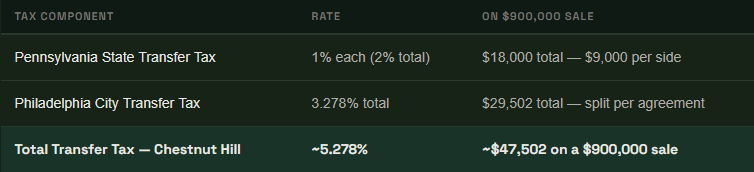
Philadelphia Realty Transfer Tax Breakdown
The communities immediately adjacent to Chestnut Hill — Wyndmoor, Erdenheim, and Flourtown in Springfield Township — deliver comparable lifestyle at Montgomery County tax rates, without Philadelphia transfer tax or city wage tax. This is a material financial difference that every Chestnut Hill seller and buyer must understand before the transaction begins.
Josh Wernick serves Chestnut Hill home sellers. The Philadelphia transfer tax implication is covered in every listing consultation. Call 267-934-5674.

Closing cost figures reflect typical ranges for Bucks County and Montgomery County, Pennsylvania transactions as of 2027. Transfer tax rates and municipal surcharges are subject to change — verify current rates for specific property addresses. Philadelphia Realty Transfer Tax rate reflects the combined city and school district rate; confirm current rate with the City of Philadelphia Revenue Department. This page is for informational purposes only and does not constitute legal or financial advice.
Related Pages:
· Sell my home in Bucks County PA
· Sell my home in Montgomery County PA
· How do I sell my house in Pennsylvania
·Pennsylvania capital gains tax on real estate
·What are seller concessions in Pennsylvania real estate
·Pennsylvania sellers property disclosure statement
What Is Negotiable — and What Is Fixed by Law
Negotiable in Pennsylvania
Transfer Tax Split - Customarily 50/50 state and local, but fully negotiable. Sellers can agree to pay more; buyers can request the seller cover the full amount.
Seller Concessions - to Buyer A buyer can request the seller contribute a fixed dollar amount toward buyer closing costs. Common on homes that have sat; uncommon on competitive listings going into 2027.
Title Company Selection In Pennsylvania -the buyer typically selects the title company.
Rates - are state-regulated but companies vary in fees. Shop rates on lender title insurance and title search.
Lender Origination Fees - Negotiable with the lender — especially for buyers with strong credit and larger down payments. Comparison shop at least two lenders.
Inspection Contingency Terms - The scope of inspection contingencies, repair requests, and credits in lieu of repairs are all negotiated as part of the offer and counter-offer process.
Fixed by Law — Not Negotiable
Pennsylvania State Transfer Tax Rate - 2% total — set by statute. The split between buyer and seller is negotiable; the rate is not.
Title Insurance Rates - Regulated by the Pennsylvania Insurance Department. Rates are filed and approved — companies cannot deviate from them.
Lender Escrow Requirements - Lenders are required to collect property tax and insurance escrows. The number of months may vary slightly by lender but the requirement itself is not waivable on most conventional loans.
Frequently Asked Questions — Pennsylvania Closing Costs
What are typical closing costs for a seller in Pennsylvania?
Seller closing costs in Pennsylvania typically run 1.5% to 3% of the sale price excluding commission. On a $600,000 Bucks County or Montgomery County home, expect $12,000 to $18,000 in closing costs before commission. The primary line items are Pennsylvania transfer tax (seller pays 1% of sale price as the standard split), owner title insurance (~$3.50 per $1,000 of coverage), deed preparation, recording fees, and prorated property taxes. Municipal transfer taxes — which vary by town — can add to this total. Josh Wernick prepares a precise net proceeds estimate for every seller before listing. Call 267-934-5674.
What are typical closing costs for a buyer in Pennsylvania?
Buyer closing costs in Pennsylvania typically run 2% to 4% of the loan amount — not the purchase price. On a $550,000 purchase with 20% down and a $440,000 loan, expect $8,800 to $17,600. Major line items include loan origination fee (0.5%–1% of loan), appraisal ($500–$800), lender title insurance (~$2.50 per $1,000 of loan), Pennsylvania transfer tax (buyer pays 1%), homeowner insurance first year, prepaid interest, and escrow setup for taxes and insurance. Home inspections ($700–$1,200) are typically paid before closing at the time of inspection.
What is the Pennsylvania real estate transfer tax?
Pennsylvania charges a 2% real estate transfer tax on every property sale — 1% paid by the seller and 1% paid by the buyer as the standard split. This split is negotiable between the parties but the 2% total rate is set by state law and cannot be waived. Many municipalities in Bucks County and Montgomery County charge additional local transfer taxes on top of the state rate. Doylestown Borough, New Hope Borough, Jenkintown Borough, and Narberth Borough each charge an additional 1%, bringing their total to 3%. Chestnut Hill, which sits within the City of Philadelphia, carries a total transfer tax of approximately 5.278% — the Philadelphia Realty Transfer Tax plus the state rate. Always verify the total rate for the specific property address before closing.
Who pays closing costs in Pennsylvania — buyer or seller?
Both parties pay closing costs in Pennsylvania, but the nature of the costs differs. Sellers typically pay transfer tax (seller half), owner title insurance, deed preparation, recording fees, and prorated property taxes. Buyers typically pay transfer tax (buyer half), lender title insurance, loan origination fees, appraisal, escrow setup, prepaid interest, and homeowner insurance. Some costs — including transfer tax split and seller concessions toward buyer costs — are negotiable as part of the purchase agreement. The title company, real estate attorney, or settlement agent prepares the closing disclosure showing every line item before settlement.
Can a seller pay the buyer closing costs in Pennsylvania?
Yes. A seller can agree to pay a fixed dollar amount toward buyer closing costs as a seller concession — negotiated as part of the offer. Seller concessions are more common on homes that have been on the market longer or when a buyer requests them as part of the offer. On competitive listings in Bucks County and Montgomery County going into 2027, seller concessions are less common because the buyer pool is competing against limited inventory. Conventional loan programs set maximum seller concession limits (typically 3% with less than 10% down, 6% with 10%–25% down). FHA allows up to 6%. VA allows up to 4%.
How are property taxes prorated at closing in Pennsylvania?
Pennsylvania property tax proration at closing is calculated on two separate cycles that do not align. School district taxes run July 1 through June 30. County and municipal taxes run January 1 through December 31. The seller is responsible for taxes covering the days they owned the property in each respective tax year. At closing, the settlement agent calculates the proration for each tax cycle separately and credits or debits the seller accordingly. Errors in tax proration are more common than they should be — verify both calculations on your settlement statement before signing. If you are unsure whether the proration is correct, your real estate attorney can review it. Josh Wernick reviews the tax proration on every transaction before the settlement statement is finalized. Call 267-934-5674.
What transfer tax does a Chestnut Hill seller pay?
Chestnut Hill sits within the City of Philadelphia — not in Montgomery County despite its suburban character. As a result, Chestnut Hill sellers and buyers pay Philadelphia Realty Transfer Tax rather than the standard Pennsylvania 2% rate. The total Philadelphia transfer tax is approximately 5.278% — the Pennsylvania state rate of 2% plus the Philadelphia city rate of approximately 3.278%. On a $900,000 Chestnut Hill home, the total transfer tax is approximately $47,500 — compared to approximately $18,000 on a comparable sale in neighboring Springfield Township communities of Wyndmoor, Erdenheim, or Flourtown, which are in Montgomery County. This is a material financial difference that every Chestnut Hill buyer and seller must account for before beginning a transaction. Josh Wernick serves Chestnut Hill home sellers and covers this in every listing consultation. Call 267-934-5674.
Are closing costs negotiable in Pennsylvania?
Some closing costs are negotiable in Pennsylvania and some are fixed by law. Negotiable: the transfer tax split between buyer and seller (customarily 50/50 but not required), seller concessions toward buyer closing costs, title company selection (and their fees for title search and examination), and lender origination fees. Fixed by law or regulation: the Pennsylvania state transfer tax rate (2% total — the split is negotiable, the rate is not), title insurance rates (regulated by the Pennsylvania Insurance Department), and recording fees (set by each county recorder of deeds). Lender escrow requirements are set by loan program guidelines and are not waivable on most conventional loans.
How much do I need to bring to closing as a buyer in Pennsylvania?
As a buyer in Pennsylvania, cash to close equals your down payment plus closing costs minus any earnest money deposit already paid. On a $550,000 purchase with 20% down: down payment of $110,000, plus closing costs of approximately $8,800 to $17,600, minus your earnest money deposit (typically $5,000 to $15,000 already paid). Total cash to close is typically $103,800 to $122,600 in this example. Your lender is required to provide a Loan Estimate within 3 days of application and a Closing Disclosure at least 3 business days before settlement — both show the exact cash to close figure. Never wire closing funds until you have verified the wire instructions directly with the title company by phone. Wire fraud in real estate transactions is a documented and ongoing threat.