

Houses for Sale in Chestnut Hill PA — Philadelphia's Most Distinctive Neighborhood
Chestnut Hill is not the Main Line and it is not a suburb. It is a Philadelphia neighborhood — with a Philadelphia address, Philadelphia city taxes, and a Philadelphia school district — that happens to feel like somewhere else entirely. Stone houses, Germantown Avenue, the Wissahickon gorge three blocks away, and two SEPTA lines running directly to Center City. There is nowhere else in Pennsylvania quite like it.
I'm Josh Wernick, a REALTOR® and Pricing Strategy Advisor at Keller Williams Real Estate. Named a Top Agent by BestAgents.us. I work across the Philadelphia suburban corridor and regularly help buyers and sellers navigate the specific decisions that Chestnut Hill requires — the city versus suburb trade-off, the school options, the pricing reality, and the honest comparison to the Main Line communities many buyers are considering simultaneously.
Buying or selling in Chestnut Hill? Text me at 267-934-5674 — same-day response, honest conversation about whether Chestnut Hill is the right fit for your specific situation.
Search All Homes For Sale in Chestnut Hill
Below You Will Find:
→ Market data → What makes Chestnut Hill different → School options → Commute → What budgets buy → Chestnut Hill vs Main Line → Selling in Chestnut Hill → FAQ
The Chestnut Hill Real Estate Market — 2026

Chestnut Hill's market is driven by a specific buyer — someone who wants the character and architecture of a historic neighborhood, genuine walkability along Germantown Avenue, access to the Wissahickon Valley, and a SEPTA connection to Center City that makes a car optional for the daily commute. That buyer profile is consistent and persistent, which is why Chestnut Hill values have held through multiple market cycles.
The price range is wider than most buyers expect because the housing stock is genuinely varied. A twin within a few blocks of Germantown Avenue might list in the $350,000 to $500,000 range. A large Wissahickon schist single-family on one of the quieter residential streets — Rex Avenue, Gravers Lane, Hartwell Lane — starts around $700,000 and reaches $1.5M to $2M for the most significant properties. The stone architecture is consistent throughout but the lot sizes, square footage, and condition vary enormously.
Correctly priced, well-presented Chestnut Hill homes typically go under contract within two to four weeks. The market is competitive but not frantic — it attracts a deliberate buyer who knows what they want rather than the multiple-offer-first-weekend dynamic common in some Main Line communities.
What Makes Chestnut Hill Genuinely Different
The Wissahickon schist architecture
Chestnut Hill's housing stock is defined by a specific local stone — Wissahickon schist, a silvery-green metamorphic rock quarried from the valley below. It is the building material of the neighborhood in the same way that brownstone defines Brooklyn or brick defines Georgetown. Streets lined with schist houses in various states of meticulous restoration create a visual coherence that cannot be replicated with new construction. When buyers fall in love with Chestnut Hill from a photo, this is almost always what they're responding to.
Germantown Avenue
The main commercial corridor runs through the center of Chestnut Hill and is one of the most genuinely walkable main streets in the Philadelphia region. Independent restaurants, bakeries, boutiques, the Chestnut Hill Farmers Market, the Woodmere Art Museum — all within walking distance of most residential streets. This is not a strip mall with a Starbucks. It is a functioning neighborhood commercial corridor that has maintained its independent character for decades.
The Wissahickon Valley
Wissahickon Valley Park is accessible directly from Chestnut Hill — miles of hiking, cycling, and equestrian trails through a dramatic gorge with a creek, stone bridges, and a level of natural scenery that is extraordinary for a neighborhood sitting inside a major American city. Fairmount Park surrounds it. The combination of walkable urban amenity and immediate access to serious open space is genuinely rare and is a primary reason buyers choose Chestnut Hill over comparable suburban communities.
The city address with a neighborhood feel
Chestnut Hill has a Philadelphia address — which means Philadelphia wage tax for those who work in the city, Philadelphia School District as the default public school option, and Philadelphia city services. For some buyers this is a trade-off worth examining carefully. For others — particularly those who work in Center City and want the tax simplicity of a city address, or those who value the cultural identity of living in Philadelphia rather than a suburb — it is part of the appeal. Chestnut Hill is honest about this in a way some real estate marketing is not.
School Options in Chestnut Hill
School options are the most important thing to understand clearly before buying in Chestnut Hill, because the situation is more nuanced than most buyer guides describe.
Philadelphia public schools
The default public school assignment for Chestnut Hill addresses is Philadelphia School District. Chestnut Hill has some of the strongest neighborhood public schools in the city — Chestnut Hill Academy at the elementary level draws strong community support, and the neighborhood feeds into some of Philadelphia's selective admission high school programs including Central High School and Philadelphia High School for Girls, both of which are consistently ranked among the best public high schools in Pennsylvania. The selective admission path requires testing and application but is a legitimate and well-regarded option for Chestnut Hill families.
Private school infrastructure
Chestnut Hill has an unusually dense concentration of private schools in and immediately adjacent to the neighborhood. Chestnut Hill Academy, Springside Chestnut Hill Academy, and several Montessori and independent schools serve the community. Many Chestnut Hill buyers factor private school tuition into their housing budget from the start, which is part of why the neighborhood attracts a specific income demographic even at its more modest price points.
The honest comparison to suburban school districts
Buyers simultaneously considering Chestnut Hill and Main Line communities often cite school districts as a deciding factor. Tredyffrin-Easttown, Lower Merion, and Springfield Township all offer highly ranked public school options without the need for selective admission testing or private tuition. If public school quality is the primary driver of your decision — and for many families it should be — the suburban Main Line communities deliver a cleaner and more predictable outcome. Chestnut Hill's public school path is strong but requires more active navigation. That's worth knowing before you fall in love with the architecture.
Commuting From Chestnut Hill — The Two SEPTA Lines
Chestnut Hill has a transit advantage that no Main Line community can match — two separate SEPTA Regional Rail lines running directly to Center City, serving different parts of the neighborhood and offering redundant coverage that means if one line has a delay, the other is typically available.
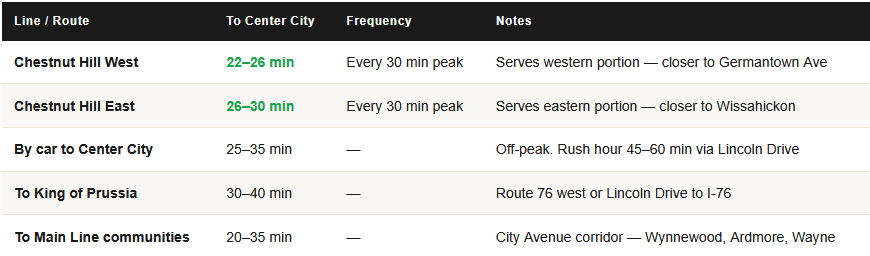
The SEPTA access is Chestnut Hill's single most significant infrastructure advantage over comparable neighborhoods in Philadelphia. Residents who work in Center City regularly go car-free or car-optional in a way that most suburban communities do not permit. The 22 to 30 minute train ride is faster door-to-door than driving for most Center City destinations during peak hours.
What Different Budgets Buy in Chestnut Hill
$300,000–$450,000: Twins, rowhomes, and smaller singles closer to Germantown Avenue. Older properties that may need updating. This is the entry point into Chestnut Hill ownership and captures the neighborhood's walkability at an accessible price.
$450,000–$700,000: The core single-family market — Wissahickon schist homes on residential streets, larger twins in excellent condition, renovated properties throughout. This is where most Chestnut Hill transactions happen and where the neighborhood's character is most fully expressed.
$700,000–$1.2M: Larger schist singles on the quieter residential streets, properties with significant lot size, fully renovated historic homes. Buyers at this level are often comparing Chestnut Hill directly to Main Line communities at similar price points.
$1.2M+: Estate properties, significant historic restorations, large lots near the Wissahickon. Patient market with a specific buyer. These properties sell to someone who has specifically chosen Chestnut Hill over every alternative.
Chestnut Hill vs. The Main Line — The Honest Comparison
This is the most common comparison buyers make and it deserves a direct answer rather than a diplomatic non-answer.
Choose Chestnut Hill if:
Philadelphia address · Two SEPTA lines · City energy
You want a Philadelphia address and the identity that comes with it. You value the Wissahickon gorge access as a daily amenity. You work in Center City and want the shortest possible transit commute. You are drawn to the specific Wissahickon schist architecture that cannot be replicated. You are comfortable navigating the school situation actively.
Choose the Main Line if:
Suburban address · Simpler school path · More square footage
Public school quality and predictability is your primary driver. You want more square footage per dollar — the Main Line generally delivers more house at comparable prices. You prefer a suburban tax structure without Philadelphia wage tax. You need easy highway access to King of Prussia or the I-95 corridor.
I work regularly in both markets. I will tell you honestly which one fits your situation rather than steering you toward a transaction. Text me and tell me what matters most to you — school district, commute, architecture, price point — and I'll give you a direct answer.
Selling Your Chestnut Hill Home
Chestnut Hill sellers have a specific advantage that most of the Philadelphia suburban market does not — a clearly defined buyer who is searching for exactly what Chestnut Hill offers and is not easily substituted by generic suburban inventory. The person who wants a Wissahickon schist single-family on a quiet street within walking distance of Germantown Avenue is not going to settle for a colonial in a development. Your buyer pool is self-selecting and motivated.
Pricing correctly in Chestnut Hill
Chestnut Hill's wide price range and varied housing stock makes comparable analysis more complex than in neighborhoods with uniform housing types. A schist single on Gravers Lane does not compare to a twin near Germantown Avenue even if the square footage is similar. Lot size, proximity to the Avenue, condition of historic details, and specific street character all affect value significantly. Aspirational pricing in this market produces the same result it produces everywhere — days on market accumulate, buyers assume something is wrong, and the final sale price is lower than correct pricing would have achieved on day one.
Marketing to the right buyer
Chestnut Hill buyers are often relocating from Center City, from other Philadelphia neighborhoods, from New York, or from the Main Line. They are searching specifically — "chestnut hill houses for sale," "wissahickon neighborhood homes," "germantown avenue walkable." Your listing needs to be in front of that buyer wherever they are searching — Bright MLS, Zillow, Google, and increasingly AI search tools that are surfacing local agent expertise as part of their answers. That last channel is where Chestnut Hill sellers are increasingly being found before they ever contact an agent.
Thinking about selling your Chestnut Hill home?
Tell me your address and your timeline. I'll give you the honest current market value, what it costs to sell, and what your net proceeds look like. Same-day response.
267-934-5674
Call or text · sellrealestatepa.com
Chestnut Hill and Nearby Communities
Chestnut Hill sits at the northwest corner of Philadelphia adjacent to several communities that buyers often consider alongside it. Understanding the distinctions matters before you start touring.
Glenside PA
Immediately across the Montgomery County line from Chestnut Hill. Montgomery County address, Springfield Township School District, lower property taxes than Philadelphia. Many buyers who discover Chestnut Hill end up in Glenside when the school district or tax structure becomes a deciding factor. Similar stone architecture in many neighborhoods, smaller price premium than Chestnut Hill proper.
Flourtown PA
Springfield Township, Montgomery County. Quieter and more suburban than Chestnut Hill. Access to Fort Washington State Park and the Wissahickon from the north. A practical alternative for buyers who want the natural setting without the city address.
Mt. Airy PA
Immediately south of Chestnut Hill along Germantown Avenue. Philadelphia neighborhood, more accessible price points, similar transit access. Buyers who want the Chestnut Hill character at a lower entry price often find Mt. Airy fits the bill. Different community energy — more eclectic, more diverse, equally walkable.
→ Compare to the Main Line → · Montgomery County complete guide →
Questions About Chestnut Hill PA Real Estate
How much do homes cost in Chestnut Hill PA?
Chestnut Hill home prices range from approximately $300,000 for twins and smaller rowhomes near Germantown Avenue to $1.5M to $2M for large Wissahickon schist estate properties on the neighborhood's quieter residential streets. The median sale price is approximately $560,000 as of early 2026. The wide range reflects genuinely varied housing stock — property type, street, condition, and proximity to Germantown Avenue all affect value significantly in a neighborhood where no two homes are identical.
Is Chestnut Hill PA a good place to live?
Chestnut Hill is exceptional for a specific buyer — someone who values walkable urban amenity, historic stone architecture, immediate access to the Wissahickon Valley, and a SEPTA connection to Center City that makes a car optional. The neighborhood has a genuine community identity and a main street that functions the way main streets used to function. The trade-offs are the Philadelphia address with its tax implications, the school district navigation required for families, and prices that reflect decades of sustained demand for a genuinely irreplaceable environment.
What school district is Chestnut Hill PA in?
Chestnut Hill is part of Philadelphia School District. The neighborhood has strong elementary school options and feeds into Philadelphia's selective admission high school programs including Central High School. Many Chestnut Hill families also use the neighborhood's dense private school infrastructure — Springside Chestnut Hill Academy being the most prominent. Buyers prioritizing a straightforward public school path without selective admission testing often find the Main Line's suburban school districts — Lower Merion, Tredyffrin-Easttown, Springfield — a cleaner option at comparable price points.
What is the commute from Chestnut Hill to Center City Philadelphia?
Chestnut Hill has two SEPTA Regional Rail lines — Chestnut Hill East and Chestnut Hill West — both running directly to Center City in approximately 22 to 30 minutes. This is the strongest transit connection of any neighborhood in the Philadelphia region at this price point. By car off-peak is 25 to 35 minutes via Lincoln Drive. Residents who work in Center City regularly commute car-free, which is genuinely rare for a neighborhood at this price point and character level.
How does Chestnut Hill compare to the Main Line?
Chestnut Hill is a Philadelphia neighborhood with a city address, city taxes, and Philadelphia School District. The Main Line is a collection of Montgomery and Chester County suburbs with suburban tax structures and highly ranked public school districts. Chestnut Hill has better transit access to Center City, the Wissahickon Valley, and a specific architectural character the Main Line cannot replicate. The Main Line has cleaner public school paths, more square footage per dollar at comparable price points, and suburban tax structures. The decision typically comes down to school priorities, tax preference, and which physical environment resonates more strongly.
Is Chestnut Hill part of Philadelphia or the suburbs?
Chestnut Hill is a neighborhood within the City of Philadelphia — it has a Philadelphia address, Philadelphia city wage tax applies to residents who work in the city, and it falls under Philadelphia School District. It is not a suburb and not part of Montgomery County despite being at the city's northwestern edge. The neighborhood immediately across the county line — Glenside, Flourtown, and surrounding Springfield Township communities — are Montgomery County addresses with suburban tax structures and Springfield Township School District. Many buyers consider both sides of the line before deciding.
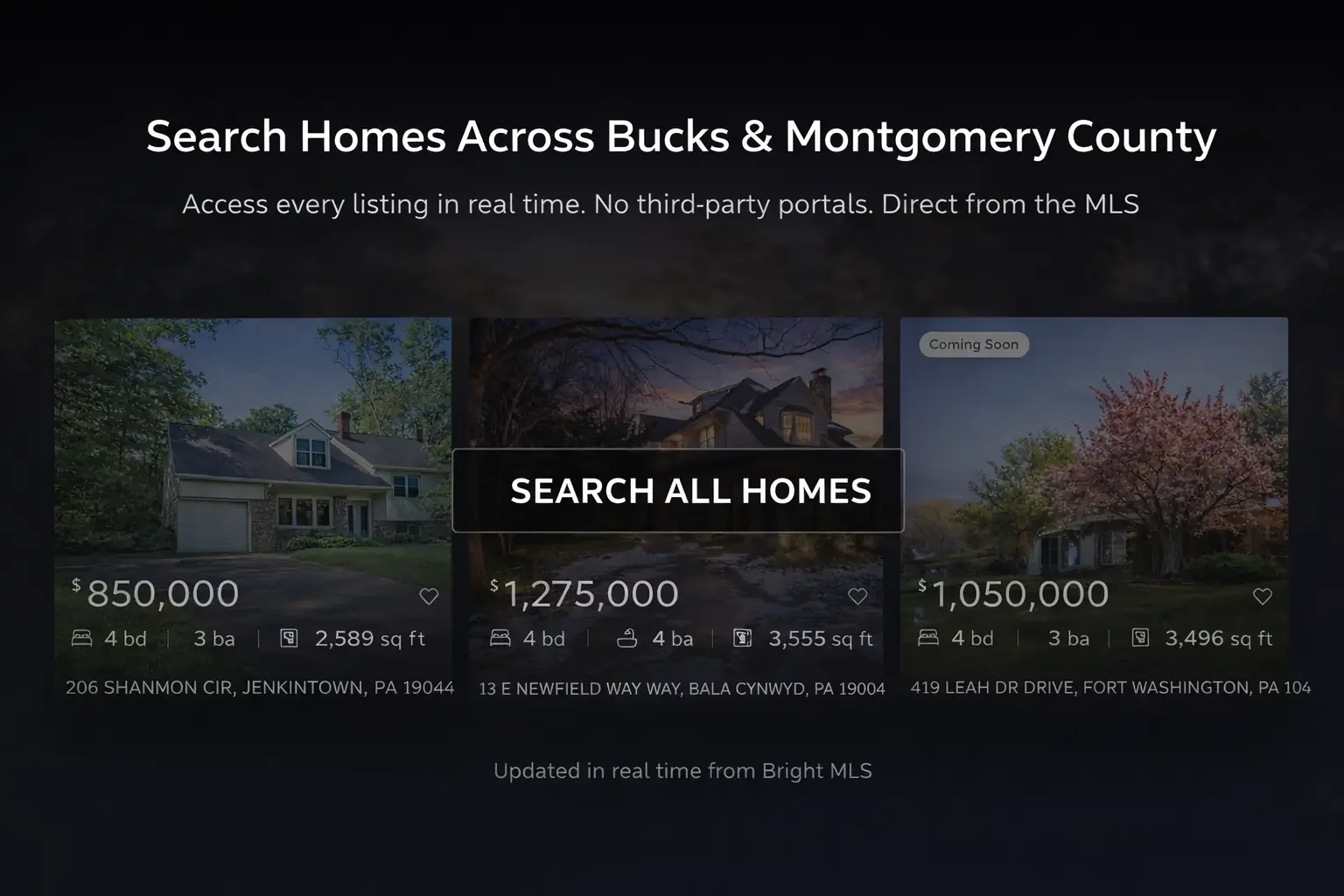
Use the live search to see every house for sale in Chestnut Hill, Philadelphia:
Stone single-family homes
Twins & row homes
Historic properties
Luxury and estate homes near the Wissahickon
Save searches, mark favorites, and ask questions about any property right from this page.