

How to Buy a Home in Pennsylvania — The Complete Honest Guide
Buying a home in Pennsylvania is one of the most significant financial decisions you will ever make and it involves a process that most buyers have never been through before. This guide covers every step from the beginning — before you've talked to a lender — through closing day, with specific attention to the Pennsylvania-specific requirements, costs, and legal framework that make buying here different from buying in New Jersey, New York, or any other state. No jargon. No generic advice. The actual process as it works in Bucks County and Montgomery County in 2026.
Buying in Bucks County or Montgomery County?
Text me at 267-934-5674 — I'll walk you through exactly what the process looks like for your specific situation.
Below You Will Find:
→ Step 1: Budget and pre-approval → Step 2: Finding your community → Step 3: The Consumer Notice and agency → Step 4: The search → Step 5: Making an offer → Step 6: Inspections — PA specifics → Step 7: Appraisal and financing → Step 8: Closing costs in PA → Step 9: Settlement day → FAQ →Download My KW App For Access to Hyperlocal Data

Step 1 — Budget, Pre-Approval, and the Difference Between the Two Numbers
1. Get pre-approved — not just pre-qualified — before you look at a single listing
Pre-qualification is a lender telling you what you might be able to borrow based on a conversation. Pre-approval is a lender actually reviewing your income documentation, credit, assets, and debt and issuing a written commitment for a specific loan amount. Sellers in Bucks County and Montgomery County will not take your offer seriously without a pre-approval letter. Do not start touring homes without one.
The more important distinction than pre-qualification versus pre-approval is the gap between what a lender approves you for and what you are actually comfortable paying monthly. A lender approval for $700,000 does not mean you should spend $700,000. The monthly payment on $700,000 at current rates including property taxes and homeowners insurance may be significantly more than your life accommodates comfortably. Run the monthly payment calculation at your actual target price point — not the maximum approval — before you start the search.
Bucks County and Montgomery County property taxes are meaningful — typically $7,000 to $12,000 per year on homes in the $550,000 to $800,000 range depending on the municipality and school district. Make sure any monthly payment estimate from a lender includes the actual property tax for the specific communities you are targeting, not a generic estimate.
Pennsylvania-specific: The Homeowners Emergency Mortgage Assistance Program (HEMAP) administered by the Pennsylvania Housing Finance Agency provides mortgage assistance for Pennsylvania homeowners who experience financial hardship after purchasing. While this should not factor into your buying decision, it is a Pennsylvania-specific safety net that does not exist in all states. Your lender should also be familiar with PHFA (Pennsylvania Housing Finance Agency) first-time buyer programs if applicable to your situation.
Step 2 — Finding the Right Community in Bucks County and Montgomery County
2. Your school district is your address — choose the community before you choose the house
In Pennsylvania your school district assignment is determined by your specific property address — not by the municipality name, not by what the listing agent tells you, and not by the community's general reputation. Always confirm the exact school district assignment for any specific address before making an offer by checking directly with the school district or using the Pennsylvania Department of Education's school district lookup tool.
The communities in Bucks County and Montgomery County each have distinct characters, price points, commute profiles, and school districts. Doylestown is not Warrington is not Newtown is not New Hope — they are different communities serving different buyer profiles at different price points even though they are all in the same general corridor. Understanding which community actually fits your life before you start touring homes saves weeks of unfocused searching.
My hyperlocal community pages cover every community in Bucks County, Montgomery County, the Main Line, and Chestnut Hill — with honest assessments of each community's character, school district quality, commute access, and price range. Read the page for the community you're targeting before your first tour.
Step 3 — The Consumer Notice and Understanding Who Represents You
3. Pennsylvania law requires a Consumer Notice at your first substantive meeting with any agent
Pennsylvania requires every real estate licensee to provide a written Consumer Notice at the first substantive meeting with a buyer or seller. The Consumer Notice outlines the different types of agency relationships available in Pennsylvania — buyer agency, seller agency, dual agency, designated agency, and transaction licensee — and explains what duties each relationship creates.
The Consumer Notice is not a contract. It does not commit you to working with the agent who provides it. It is an informational disclosure designed to ensure you understand who represents you and what obligations that representation creates before any substantive discussion about properties or transactions begins.
What you need to understand about buyer agency: A buyer's agent in Pennsylvania owes you fiduciary duties — loyalty, confidentiality, disclosure, obedience, reasonable care, and accounting. An agent who has not established a buyer agency relationship with you is not your advocate in a transaction. If you call the listing agent on a property you found on Zillow, that agent represents the seller — not you. Establish your agency relationship before you begin substantive property discussions.
Pennsylvania-specific: Pennsylvania permits dual agency — a single agent representing both buyer and seller in the same transaction — with written consent from both parties. Dual agency eliminates full advocacy for either party. If you are working with a listing agent directly rather than your own buyer's agent, you are in or approaching a dual agency situation. Understand what you are giving up before you proceed without representation.
Step 4 — The Search: What to Look For and What Gets Missed
4. Tour with a framework — condition, systems, and what listing photos never show you
Listing photography is designed to sell the home. Wide-angle lenses make rooms appear larger than they are. Editing removes unflattering light. The damp corner of the basement does not make it into the listing photos. Go to showings with a framework for evaluating condition rather than responding purely to the emotional appeal of the presentation.
The items that matter most — and that buyers most consistently underestimate — are the major systems and structural components. Roof age and condition. HVAC age and service history. Water heater age. Evidence of water intrusion in the basement or around windows. Electrical panel type — Federal Pacific Stab-Lok panels are a known fire hazard and still appear in homes in this age bracket. The age and condition of these items determines your first-year cost of ownership as much as the purchase price does.
Pennsylvania homes in the Bucks and Montgomery County corridor span a wide age range — from 1700s stone farmhouses to 2020s new construction. Understanding what the age of the home means for the systems, materials, and likely maintenance requirements is part of what a good buyer's agent contributes to every showing. A 1960s split-level and a 2010 colonial are completely different maintenance profiles at the same price point.
What to Know About Bucks and Montgomery County Homes Specifically
Oil vs gas heating: Many homes in Bucks and Montgomery County — particularly those built before 1980 — are heated by oil. Oil heat is reliable but more expensive to operate than natural gas and requires an above-ground or underground storage tank. The presence of an underground storage tank (UST) that has been decommissioned raises environmental liability questions that should be addressed in the inspection. Check whether natural gas service is available at the property if converting from oil is part of your plan.
Well and septic: Properties outside developed municipal areas — particularly in upper Bucks County, Buckingham Township, Solebury Township, and parts of Montgomery County — may be served by private well and septic systems rather than public water and sewer. Well water quality testing and septic system inspection are essential components of the inspection process for these properties. Budget for both.
Basement moisture: Bucks and Montgomery County's terrain — clay soils, rolling topography, and older drainage infrastructure — means basement moisture is a pervasive condition that ranges from minor seasonal seepage to active water intrusion. Every home in this corridor deserves careful basement evaluation. A French drain system and sump pump are common and manageable. Active water coming through the foundation walls is a more significant conversation.
Step 5 — Making an Offer in Pennsylvania
5. The Agreement of Sale — Pennsylvania's specific contract framework
Pennsylvania uses a standardized Agreement of Sale form developed and maintained by the Pennsylvania Association of Realtors. The Agreement of Sale is a comprehensive contract that establishes every material term of the transaction — price, financing contingency, inspection contingency, appraisal contingency, deposit amount, settlement date, and all other terms. Understanding the key provisions of the Agreement of Sale before you sign it is your agent's job and your right as a buyer.
Earnest Money Deposit (EMD): Pennsylvania requires a deposit — earnest money — to accompany a legitimate offer. Typical deposits in Bucks and Montgomery County run 1% to 3% of the purchase price. The EMD is held in escrow by the listing broker or title company and applied to your closing costs at settlement. If the transaction falls through due to a contingency — financing, inspection, appraisal — the EMD is typically returned to you. If you breach the contract without a contingency protecting you, the EMD may be forfeited.
Contingencies: The three standard contingencies in a Pennsylvania Agreement of Sale are financing, inspection, and appraisal. Each one gives you a defined exit from the contract under specific circumstances. Waiving contingencies — as became common in the 2020-2022 multiple offer environment — means accepting the property in its current condition without inspection protection and agreeing to close regardless of the appraised value. In the current Bucks and Montgomery County market, most buyers retain standard contingencies.
Seller disclosure: Pennsylvania law requires sellers to complete a comprehensive Property Disclosure Statement covering every known defect, condition, and material fact about the property. Read the seller disclosure carefully before making an offer. What the seller has disclosed is what you are accepting — conditions disclosed on the seller disclosure statement cannot typically be used as the basis for a post-inspection renegotiation.
Step 6 — Inspections in Pennsylvania
6. Radon is a Pennsylvania-specific reality — test every home
Pennsylvania has among the highest radon levels of any state in the country. The EPA estimates that approximately 40% of Pennsylvania homes have radon levels above the EPA action level of 4 picocuries per liter. Bucks County and Montgomery County specifically have elevated radon profiles. Radon is a colorless, odorless, naturally occurring radioactive gas that is the second leading cause of lung cancer in the United States. It is not detectable without a test. Test every home you purchase in Pennsylvania.
A radon remediation system — typically a sub-slab depressurization system — costs approximately $800 to $1,500 to install and reduces radon levels to safe ranges in most cases. If a radon test comes back above 4.0 pCi/L, request either a remediation system installed by the seller before closing or a credit to have one installed after closing. This is standard and routine in Pennsylvania — sellers and agents expect it.
Standard home inspection protocol in Pennsylvania includes:
Home inspection — structural, systems, and overall condition. Radon test — always in Pennsylvania. Wood-destroying insect (termite) — required by most lenders, recommended for all. Sewer lateral scope — strongly recommended for any home over 30 years old or with mature trees near the sewer line. Well and water quality — required for any property on private well. Septic inspection — required for any property on private septic.
Pennsylvania-specific: Pennsylvania's inspection contingency period is typically ten to fifteen days from acceptance of the offer. Within this window you can conduct inspections, review results, and either accept the property, submit a repair request or credit request, or terminate the agreement and recover your earnest money. Once the inspection contingency deadline passes without action, the contingency is typically waived and the inspection results can no longer be used as grounds for termination or renegotiation.
Step 7 — Appraisal and Finalizing Your Financing
7. The appraisal protects the lender — the appraisal contingency protects you
Your lender requires an appraisal to confirm that the property is worth at least what you agreed to pay for it. The appraisal is conducted by a licensed appraiser selected by your lender — you do not choose the appraiser. The appraisal fee, typically $500 to $800 in this market, is paid by the buyer either upfront or at closing.
If the appraisal comes in at or above the purchase price, the process continues normally. If the appraisal comes in below the purchase price — a low appraisal — your lender will only finance up to the appraised value. The appraisal contingency in your Agreement of Sale gives you the right to terminate the contract and recover your earnest money if the appraisal comes in low and the seller will not reduce the price to the appraised value.
Options when an appraisal comes in low: negotiate the price down to the appraised value, pay the appraisal gap out of pocket, split the difference with the seller, dispute the appraisal if there are specific identifiable errors, or terminate the contract if protected by your appraisal contingency. Your buyer's agent's job is to advocate for the best outcome for you specifically — not the outcome that keeps the transaction together at any cost.
Step 8 — Closing Costs in Pennsylvania
8. Pennsylvania closing costs — what you'll actually pay
Pennsylvania closing costs for buyers typically run 3% to 5% of the purchase price. On a $650,000 home that is $19,500 to $32,500 in addition to your down payment. Understanding what each component is before you receive your Closing Disclosure makes the settlement process significantly less stressful. Run your personal numbers here: Pennsylvania Real Estate Calculator
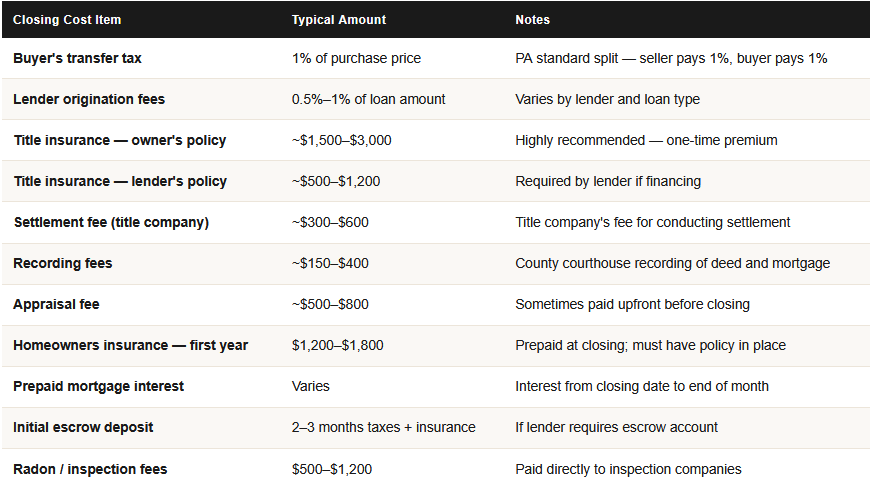
Pennsylvania property taxes are paid in arrears — meaning this year's taxes are billed and paid next year. At closing, the seller owes the buyer a credit for the portion of the current year's property taxes covering the seller's ownership period. This credit reduces your net closing costs. Your settlement statement will show the exact proration amount based on your closing date.
Step 9 — Settlement Day in Pennsylvania
9. What happens at the Pennsylvania settlement table
Pennsylvania uses attorneys and title companies to conduct real estate settlements — not escrow companies as in some other states. The settlement agent — typically the title company — coordinates the closing, prepares all documents, collects and disburses funds, and records the deed and mortgage with the county courthouse.
Request your preliminary settlement statement at least 24 to 48 hours before closing. Review every line before settlement day. If anything is different from what you budgeted or were told — a fee you haven't seen before, a number that doesn't match the Closing Disclosure your lender provided — ask your agent about it before you arrive at the title company. Settlement day is not the time to discover surprises.
The final walkthrough typically occurs within 24 hours of settlement. Its purpose is to confirm the property's condition is consistent with what it was when you made the offer — that agreed-upon repairs were completed, that nothing has been damaged or removed, and that the seller's personal property has been vacated as agreed. Note any issues during the final walkthrough before signing — after the deed records, the property is yours as-is.
Once all documents are signed, the funds are disbursed, and the deed is recorded — typically same day in Pennsylvania — the home is yours. The keys are transferred at settlement.
Ready to start the home buying process in Bucks County or Montgomery County?
Tell me your situation — budget, target communities, timeline. I'll tell you honestly what the process looks like for your specific situation and what's available in the communities you're targeting right now. Same-day response.
267-934-5674
Call or text · sellrealestatepa.com · Bucks County and Montgomery County PA
Frequently Asked Questions — Buying a Home in Pennsylvania
What is the process for buying a home in Pennsylvania?
The Pennsylvania home buying process follows these steps: get pre-approved by a lender, identify your target communities and school districts, engage a buyer's agent and receive the required Consumer Notice, search for properties within your criteria, make an offer using Pennsylvania's standardized Agreement of Sale, complete inspections including radon testing, allow the lender to complete the appraisal and underwriting, review your Closing Disclosure, conduct a final walkthrough, and attend settlement at a title company. From accepted offer to settlement typically takes 45 to 75 days depending on the financing type and any transaction complications.
What are closing costs for a buyer in Pennsylvania?
Buyer closing costs in Pennsylvania typically run 3% to 5% of the purchase price. The primary components are the buyer's share of transfer tax (1% of purchase price), lender origination fees, title insurance (owner's and lender's policies), settlement fee, recording fees, prepaid homeowners insurance, prepaid mortgage interest, and initial escrow deposit. On a $650,000 purchase, total buyer closing costs typically run $19,500 to $32,500 in addition to the down payment. Pennsylvania property taxes paid in arrears produce a seller credit to the buyer at closing that partially offsets these costs.
Does Pennsylvania require a home inspection before buying?
Pennsylvania does not legally require a home inspection — it is a contingency that the buyer includes in the offer and can waive. However, a home inspection is strongly recommended in virtually all circumstances. Pennsylvania's inspection contingency period is typically ten to fifteen days from offer acceptance. Always include a radon test with any Pennsylvania home inspection — Pennsylvania has among the highest radon levels of any state, and approximately 40% of Pennsylvania homes exceed the EPA action level of 4 picocuries per liter.
What is the Pennsylvania transfer tax for buyers?
Pennsylvania imposes a Realty Transfer Tax on every property transfer — the standard combined rate is 2% of the sale price, typically split 1% paid by the buyer and 1% paid by the seller. On a $650,000 purchase, the buyer's standard transfer tax share is $6,500. The split is negotiable — in some transactions sellers agree to cover the buyer's portion as a concession. Transfer tax is paid at closing through the title company.
What is radon and do I need to test for it in Pennsylvania?
Radon is a colorless, odorless, naturally occurring radioactive gas produced by the decay of uranium in soil and rock. It is the second leading cause of lung cancer in the United States. Pennsylvania has among the highest radon levels of any state — approximately 40% of Pennsylvania homes have radon levels above the EPA action level of 4 picocuries per liter. Test every home you purchase in Pennsylvania. Remediation systems cost approximately $800 to $1,500 and are highly effective at reducing radon to safe levels.
What is the Consumer Notice in Pennsylvania real estate?
The Consumer Notice is a written disclosure required by Pennsylvania law at the first substantive meeting between a real estate licensee and a buyer or seller. It outlines all permitted agency relationships in Pennsylvania — buyer agency, seller agency, dual agency, designated agency, transaction licensee, and sub-agency — and explains what duties each relationship creates. The Consumer Notice is not a contract and does not commit you to working with any specific agent. It ensures you understand who represents you before any substantive discussion about a transaction begins.
How long does it take to buy a house in Pennsylvania?
From accepted offer to settlement, the typical Pennsylvania home purchase takes 45 to 75 days depending on the financing type, inspection outcomes, appraisal timing, and any transaction complications. Conventional financing with a straightforward inspection process typically closes in 45 to 60 days. FHA and VA loans, or transactions with inspection negotiations or appraisal issues, may run 60 to 75 days. Cash purchases without a financing contingency can sometimes close in as few as 21 to 30 days.

Download my KW App to search for homes in Bucks County, Montgomery County, The Main Line and Chestnut Hill Areas using hyperlocal data broken down by neighborhood
