

Commercial Real Estate in Bucks County PA — What This Market Actually Looks Like
Bucks County's commercial market doesn't fit neatly into a single description. The stretch from Bensalem's Route 1 industrial corridor to a Doylestown Borough storefront to a Solebury Township mixed-use property being rezoned for the first time in 40 years — these are genuinely different commercial environments. Understanding which one you're dealing with determines everything about your strategy.
I'm Josh Wernick, a REALTOR® at Keller Williams serving commercial buyers, sellers, tenants, and investors across Bucks County. I've spent years studying this market's commercial inventory — before I was an agent — as a small business owner trying to find, buy, and lease commercial space here and found the process unnecessarily difficult. Part of why I got into real estate was to be the person I couldn't find when I needed one. Good luck getting a commercial agent in this area to respond when you leave a voicemail. That's where I'm different — 267-934-5674, call or text me and start the conversation about your commercial real estate goals whether buying, leasing, or selling.



The Bucks County Commercial Market — Current Data
Updated October 2026 · Sources: CommercialCafe, CommercialLoanDirect, SelectCommercial, LoopNet, PropertyShark, local transaction data

The Bucks County Commercial Market — By the Numbers
302 active commercial listings across all platforms as of September 2026. The county spans 622 square miles with 54 municipalities, each with its own zoning code. What's available in Langhorne at $10 per square foot and what's available in Washington Crossing at $29 per square foot are fundamentally different markets requiring fundamentally different approaches.
Lower Bucks County (Bensalem, Bristol, Levittown, Langhorne, Fairless Hills) is a legitimate industrial and logistics hub. Proximity to I-95, the Pennsylvania Turnpike, and the New Jersey bridge crossings makes lower Bucks a distribution and warehousing corridor with genuine institutional buyer interest. Industrial buildings here trade at $11 to $12 per square foot for lease and $150 to $200 per square foot for sale. This is where the highest transaction volume in Bucks County commercial is concentrated, and where sophisticated out-of-county investors are consistently active.
Central Bucks County (Doylestown, Warrington, Warminster, Chalfont, Newtown, Yardley) is where small-to-mid commercial opportunities are densest. Class A office along the Route 611 and I-95 corridors at $17 to $24 per square foot. Retail in Doylestown Borough at $21 per square foot. Flex and office hybrid in Chalfont at $22 per square foot. This is the market most local business owners and professionals are navigating — and where the absence of responsive commercial agent representation is most acutely felt.
Upper Bucks County (Quakertown, Perkasie, Sellersville, Riegelsville, Ottsville) offers the most accessible entry price points in the county. Industrial space in Perkasie at $7.75 to $8.25 per square foot. Commercial buildings and land at prices that make lower and central Bucks look expensive. The trade-off is commute distance, smaller consumer base, and more complex agricultural and rural zoning that requires careful verification before any commercial acquisition.
Commercial Financing Rates — October 2026
The 10-year Treasury is sitting at 5.31% and prime is at 7.00% as of October 6, 2026. That context matters for every commercial acquisition conversation.
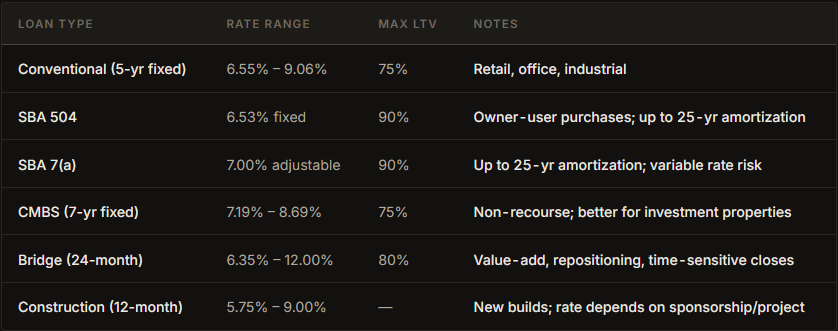
Source: CommercialLoanDirect.com & SelectCommercial.com · October 5–6, 2026. Rates represent best-case pricing scenarios and are subject to underwriting. Key indexes: Prime 7.00% · 30-Day SOFR 3.78% · 10-Yr Treasury 5.31%
What Makes Bucks County Commercial Real Estate Distinct
The Historic Character Premium and the Complexity It Creates
Bucks County has an unusually high concentration of historic buildings — including commercial structures — that carry both character value and regulatory complexity. A 1789 retail building in Newtown Borough at $3.57 per square foot per year exists in a historic district with design review requirements. The Main Street character of Doylestown, New Hope, and New Britain boroughs is a genuine asset to commercial tenants — foot traffic, community identity, destination character — but it comes with preservation overlay requirements that don't exist in suburban strip center markets.
The Delaware River and NJ Proximity Advantage
Lower Bucks is one of the few suburban Philadelphia markets with direct bridge access to New Jersey's Route 1 corridor and Trenton metro. For distribution, logistics, and businesses with dual-market customer bases, this is a genuine location advantage. The Bristol and Bensalem industrial parks — within minutes of I-95 and the Turnpike, accessible to both Philadelphia and NJ markets — attract users that the more landlocked Montgomery County industrial parks can't serve as efficiently.
The Agricultural Zoning Wild Card
Upper and central Bucks County has more agricultural and rural residential zoning than most buyers expect when they see a commercial listing. A property listed as "commercial" may be in a zoning district where that designation refers to a small node of permitted uses surrounded by agricultural or low-density residential zoning. What's permitted by-right, what requires conditional use, and what would require a variance must be verified against the specific municipality's ordinance before any commercial acquisition in upper or rural Bucks County. This is not optional due diligence — it's where deals get killed most often.
Borough Commercial vs. Township Commercial
Bucks County's boroughs — Doylestown, Newtown, New Hope, Perkasie, Sellersville, Quakertown, Yardley, Bristol — have different commercial zoning frameworks than the surrounding townships. Borough commercial tends to be walkable, mixed-use, pedestrian-oriented, and subject to historic district review in many cases. Township commercial tends to be highway-oriented, larger-format, and more auto-dependent. A restaurant in Doylestown Borough operates in a completely different regulatory and operational environment than a restaurant on Route 611 in Doylestown Township. Understanding which environment fits your business model is foundational to the search.
Commercial Property Types in Bucks County — What They Cost
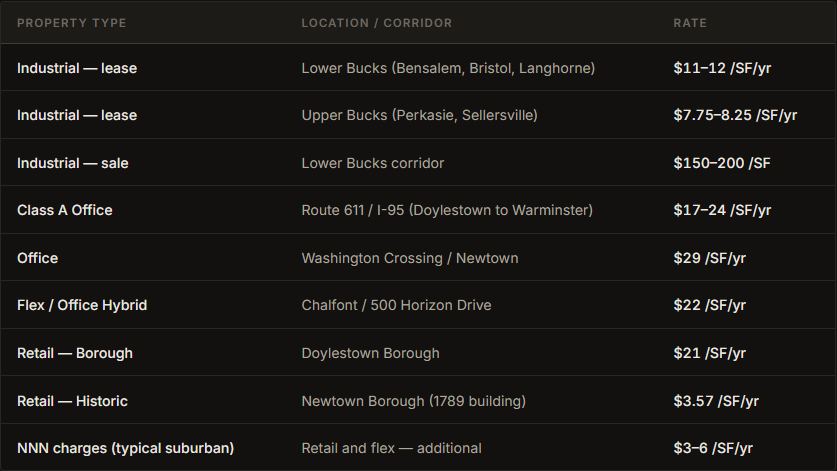
Actual pricing depends on specific property condition, location within corridor, lease term, and tenant credit. For context: the Philadelphia metro industrial market is running 11% vacancy (above the national 9.3%), with asking rents around $9.29/SF — meaning lower Bucks industrial is priced at a premium to the regional average. Contact for current market comparable data on any specific property type.
Bucks County Commercial Corridors — Where to Look by Need
Lower Bucks — Industrial, Logistics, and Route 1 Retail
Route 1 (Lincoln Highway) industrial, flex, big-box retail — Bensalem through Levittown. High-volume traffic, large-format users, I-95/I-276 access. Strongest industrial corridor in the county.
I-95 and Street Road corridor — industrial, warehouse, distribution — Bensalem, Langhorne, Bristol Township. One mile from I-95, direct bridge access to New Jersey.
Bristol Borough and Levittown — light industrial, small retail. Most affordable commercial price points in lower Bucks. 17,100 to 61,448 SF industrial available at $11.95 per square foot.
Fairless Hills and Falls Township — industrial, flex, NNN investment. Former steel manufacturing legacy. Large-parcel industrial, good Turnpike access. Revitalization activity.
Central Bucks — Office, Retail, Mixed-Use, Corporate
Route 611 corridor — retail, office, medical — Doylestown to Warminster. The primary commercial artery. Class A office $17 to $24 per square foot. Retail varies widely by visibility.
Doylestown Borough — retail, restaurant, professional. State Street and Main Street. High pedestrian traffic, destination character. Retail at $21 per square foot. Very limited vacancy. Historic district regulations apply.
Newtown Borough and Township — office, retail, corporate. Historic Newtown Borough at $29 per square foot (Washington Crossing office). Newtown Township I-95 corridor for corporate office. Office condos available for owner-user purchase.
Chalfont and Montgomeryville border — flex, office hybrid. 500 Horizon Drive flex and office at $22 per square foot. Good Route 202 and 309 cross-access.
Warminster and Warrington Route 611 — retail, medical, office. Growing suburban commercial node. Large anchored retail, medical office, suburban professional. Good population density support.
I-95 and Newtown-Yardley corridor — corporate office, technology. Lower Makefield through Newtown Township. Corporate campuses, Council Rock School District residential support for ancillary commercial.
New Hope Borough — retail, restaurant, gallery. Tourism-driven, destination commercial. Highest per-square-foot rents in Bucks County for prime borough spaces. Seasonal and year-round demand.
Upper Bucks — Value, Rural, Agricultural Mixed-Use
Quakertown Borough and Route 309 — retail, office, light industrial. Affordable Main Street commercial, good highway access to both Philadelphia and Lehigh Valley. Growing population base. Current active listing: 534 W. Broad Street, Quakertown PA — $625,000 C2 mixed-use.
Perkasie and Sellersville — industrial, light manufacturing. Industrial at $7.75 to $8.25 per square foot — among lowest lease rates in the county.
Upper Bucks Route 412 and 313 — rural commercial, agricultural adjacent. Small commercial nodes in largely rural-agricultural zoning. Require careful zoning verification. Accessible for buyers who need land without premium location pricing.
The Restaurant and Bar Category — A Special Note
Bucks County has an active market for restaurant and food-service commercial spaces — both for lease and sale. A fully permitted kitchen with hood system, grease trap, walk-in cooler, and appropriate plumbing and electrical can represent $150,000 to $400,000 in infrastructure cost that a buyer inherits when they acquire or lease a built-out restaurant space. If you're in the food-service business looking for a location in Bucks County, evaluate existing restaurant build-outs as infrastructure acquisitions first, lease economics second.
Buying Commercial Property in Bucks County PA
Owner-User Purchases
For Bucks County small business owners who have been paying rent on commercial space and whose business is profitable and established — purchasing your building is worth a serious conversation. The math in many cases shows that owning is less expensive per month than leasing equivalent space, while building equity in an asset that appreciates alongside the county's strong residential demand. Call Josh Wernick - REALTOR® at 267-934-5674 to discuss what's currently available for owner-user purchase in your specific area and price range.
Investment Purchases — What Works in Bucks Right Now
For commercial investors, three categories offer the most compelling risk/return profiles in Bucks County in 2026: Route 1 and I-95 industrial — tight vacancy, consistent tenant demand from logistics and distribution users, good cap rates for the risk profile. Mixed-use borough buildings — ground-floor commercial with residential above in Doylestown, Newtown, New Hope, and Yardley. The residential component has appreciated significantly; the commercial component is often priced on historical commercial-only metrics. Value-add suburban office — small-to-mid suburban office buildings that have below-market rents and need updating are trading at cap rates that reflect today's office skepticism.
Looking to Buy Commercial Property in Bucks County?
Tell me your target property type, square footage, location preference, and whether you're buying for your business or as investment. I'll tell you what's actually available, what the zoning allows, and what the due diligence process looks like.
📞 267-934-5674 · ✉️ joshwernick@kw.com
Selling Commercial Property in Bucks County
Bucks County commercial sellers face a specific market dynamic: the buyer pool varies dramatically by location. A Doylestown Borough storefront has a deep pool of local business tenants who know the market and want to be there. A Route 1 industrial building has an institutional and regional investor pool that reads LoopNet and CoStar daily. An upper Bucks rural commercial property has a limited and highly specific buyer pool that requires targeted outreach.
Pricing commercial property in Bucks County correctly requires understanding which pool your property is in, how deep that pool is, and what timeline that implies. I will not tell you a number designed to get the listing. I will tell you what the market says your property is worth, who the likely buyers are, and what a realistic marketing timeline looks like for your specific property type and location.
Preparing a Bucks County Commercial Property for Sale
For tenanted properties: organize your rent rolls, lease copies, operating expense history for the last three years, utility history, and any maintenance records. Buyers and their lenders will request all of this during due diligence — having it organized from day one signals a professional seller and supports your price.
For owner-occupied properties: you'll need to establish what the market rent would be for the space because investment buyers will underwrite on an assumed market rent, not your historical self-occupancy cost.
Environmental considerations: if your property has any history of industrial use, auto service, dry cleaning, printing, or other potentially contaminating uses, proactively obtaining a Phase I ESA before listing eliminates a major buyer uncertainty and speeds due diligence.
Looking to Sell Your Commercial Property in Bucks County?
Tell me your time frame and your address. I'll tell you what is realistic in this market.
📞 267-934-5674 · ✉️ joshwernick@kw.com
Leasing Commercial Space in Bucks County PA
The tenant experience problem — and why it matters here
The documented experience of commercial tenants in the Bucks and Montgomery County market consistently cites the same problem: agents who won't return calls, listings that show available but aren't, and brokers focused entirely on large institutional transactions who treat sub-5,000 sq ft users as an afterthought. I have been on that side of this market. I understand what it feels like to need a space for your business and be unable to get a straight answer from anyone.
If you contact me about a commercial space in Bucks County, you will hear back the same day. That's not a marketing claim — it's a direct response to the industry's documented failure at this.
Understanding Your Lease Before You Sign
Pennsylvania commercial leases are not standardized. Everything is negotiated. The most important terms to understand and negotiate before you sign:
Base rent and rent escalations — most commercial leases include annual rent escalations of 2 to 3% or CPI-adjusted. On a 5-year lease, a 3% annual escalation means your rent in year 5 is 16% higher than year 1. Understand the total committed payment over the full lease term.
NNN charges — triple-net charges in Bucks County suburban retail and flex typically run $3 to $6 per square foot per year in addition to base rent. Ask the landlord for the actual NNN reconciliation from the last two years — not just the estimated monthly amount.
Permitted use clause — negotiate for broad enough language to accommodate reasonable business evolution. A permitted use clause that says "retail sale of women's clothing" restricts you from adding a coffee bar or expanding product categories.
Exclusivity — in multi-tenant properties, ask whether exclusivity provisions are available for your business category.
Signage and visibility rights — negotiate your signage rights explicitly in the lease, not as an afterthought.
Zoning in Bucks County — Why 54 Municipalities Makes This More Complex Than Anywhere Else
Bucks County has 54 municipalities — 54 separate zoning ordinances, 54 sets of permitted use schedules, 54 zoning hearing boards, and 54 different histories of how commercial development has been managed. No other factor explains more commercial real estate failures in Bucks County than zoning that wasn't verified before the offer was signed.
The Three Zoning Situations That Kill Deals Most Often
1. The agricultural zone commercial listing. A listing described as "commercial property" in upper or central Bucks County may be a building that was historically used commercially but sits in an agricultural or rural residential zoning district. The previous commercial use may be legally non-conforming — meaning it can continue until it's abandoned or substantially changed, but cannot be expanded, converted to a different use, or in some cases even transferred to a new owner without triggering compliance review. Always verify whether a commercial use is permitted by-right or exists as a legal non-conformity.
2. The borough historic district overlay. Doylestown Borough, New Hope Borough, and several other Bucks County boroughs have historic district designations that impose design review requirements on commercial renovations and new signage. A business that wants to modify the storefront, add outdoor seating, or change the facade needs historic commission approval in addition to standard building permits. This adds 30–90 days to any renovation timeline. Know this before you commit to a space with a needed renovation.
3. The liquor license and restaurant zoning intersection. Pennsylvania liquor licensing and local zoning sometimes conflict in ways that catch restaurant operators by surprise. A location may be commercially zoned and physically suitable for a restaurant, but the zoning ordinance may restrict uses within a certain distance of schools, churches, or residential zones in ways that affect LCB approval. Verify the zoning, the distance restrictions, and the LCB requirements simultaneously before committing to a restaurant location.
How I Handle Zoning
Before I show any commercial property to a buyer or tenant, I verify the zoning district, the permitted use schedule for that district, and whether the client's intended use is by-right, conditional use, or requiring a variance. For conditional use situations, I estimate the timeline and cost before the client commits — not after. For variance situations, I advise clients honestly about the risk and timeline and help them assess whether the property is worth the regulatory uncertainty.
I have studied zoning across all 54 Bucks County municipalities. I know which townships have progressive mixed-use ordinances, which boroughs have active historic commissions with specific design preferences, and which rural townships have restrictive agricultural-residential zoning that makes commercial investment complex. That knowledge changes the search strategy and protects clients from the deals that look good on paper and collapse in due diligence.
How I Work — And What's Different
I answer the phone. I respond to emails the same day. I know the inventory in Bucks County commercial from years of studying it before I was a REALTOR® — not from running a portal search the morning you called. I understand the zoning across all 54 municipalities at the level needed to give you a real answer before you commit to due diligence.
I am not a large institutional commercial brokerage. I don't have 50 agents and a minimum transaction size. I work across the full spectrum of Bucks County commercial — from a business owner looking for 2,500 SF of flex space in Warminster to an investor evaluating a Route 1 industrial building to an individual trying to figure out whether a Doylestown Borough storefront works for their restaurant concept before they sign a 5-year lease.
I also work residential real estate across Bucks County, which gives me a specific advantage in commercial investment analysis. I know which residential neighborhoods are growing, which school districts are driving population pressure into specific commercial trade areas, and which communities have the household income profile to support specific commercial uses. Commercial investors who ignore the residential context of their commercial locations make worse decisions than those who integrate it.
Every client gets my direct number. 267-934-5674. That's the entire offer.
"Josh is incredibly dedicated and hard working. I would highly recommend him to anyone looking to buy or sell."
— Erin W. ⭐⭐⭐⭐⭐ Google Review
"Josh will go above and beyond to help you in any way he is able! I highly recommend him if you are looking for a real estate agent!!"
— Diane H. ⭐⭐⭐⭐⭐ Google Review
"Josh is the BEST — he'll do everything in his power to get you and your family where you need to be."
— Jessica H. ⭐⭐⭐⭐⭐ Google Review
Also serving: Montgomery County commercial real estate · Residential in Bucks & Montgomery County
Frequently Asked Questions — Commercial Real Estate in Bucks County PA
What is the current commercial real estate market like in Bucks County PA?
As of September 2026, Bucks County has 302 active commercial listings — 229 for lease totaling 15.9 million square feet and 61 for sale totaling 10.3 million square feet. The market is bifurcated between lower Bucks (industrial and logistics driven, highest transaction volume) and central/upper Bucks (office, retail, and mixed-use). Lower Bucks industrial space leases at $11–$12 per square foot; central Bucks Class A office runs $17–$24 per square foot; Doylestown Borough retail sits at approximately $21 per square foot.
What are current commercial mortgage rates in Pennsylvania?
A: As of October 2026, conventional commercial mortgages (5-year fixed) are running 6.55%–9.06% with 75% LTV maximums. SBA 504 loans for owner-user commercial purchases are at 6.53% fixed with up to 90% LTV and 25-year amortization — the most favorable program for small business owners buying their building. SBA 7(a) is at 7.00% adjustable. Bridge loans range from 6.35% to 12.00%. The 10-year Treasury is at 5.31% and prime rate is 7.00%.
How does Bucks County zoning work for commercial real estate?
Bucks County has 54 municipalities, each with its own zoning ordinance and permitted use schedule. Commercial use must be verified for each specific property before any offer is signed. The three most common zoning problems that kill deals: agricultural zone commercial listings (a property may be legally non-conforming and unable to expand or change use), historic district overlays in boroughs like Doylestown and New Hope (requiring historic commission approval that adds 30–90 days to renovations), and the liquor license and zoning intersection for restaurant operators.
Should I buy or lease commercial space in Bucks County?
For established, profitable businesses that have been renting commercial space, the buy vs. lease math often favors ownership — monthly ownership costs are frequently lower than equivalent lease costs, while building equity in an appreciating asset. SBA 504 loans allow owner-user purchases at up to 90% LTV with 6.53% fixed rates as of October 2026. The decision depends on your specific space need, business stability, available capital, and how long you plan to operate from the location. Call 267-934-5674 to run the numbers for your situation.
What commercial real estate is available in lower Bucks County PA?
Lower Bucks County (Bensalem, Bristol, Levittown, Langhorne, Fairless Hills) is the county's primary industrial and logistics corridor. Industrial and flex space leases at $11–$12 per square foot and sells at $150–$200 per square foot. The Bristol and Levittown corridor has active inventory at approximately $11.95 per square foot with buildings ranging from 17,100 to 61,448 square feet. Proximity to I-95, the Pennsylvania Turnpike, and NJ bridge crossings makes this the highest-transaction-volume commercial market in the county.
What commercial properties are available in Doylestown PA?
Doylestown Borough retail and professional space runs approximately $21 per square foot on State Street and Main Street corridors, with very limited vacancy. The borough is subject to historic district design review requirements for renovations and signage changes. Doylestown Township on Route 611 offers larger-format suburban commercial at lower per-square-foot rates. Contact Josh at 267-934-5674 for current availability in either market.
What NNN charges should I expect in a Bucks County commercial lease?
Triple-net (NNN) charges in Bucks County suburban retail and flex space typically run $3–$6 per square foot per year on top of base rent. Always ask the landlord for actual NNN reconciliation statements from the last two years — not just the estimated monthly figure. The reconciliation shows what taxes, insurance, and maintenance actually ran, which often differs from estimates. NNN caps and gross lease alternatives are negotiable on some properties.
How do I find a commercial real estate agent in Bucks County PA?
A: Josh Wernick is a licensed REALTOR® at Keller Williams serving commercial buyers, sellers, tenants, and investors across all 54 Bucks County municipalities. Named 2026 Top Agent for Bucks County and Montgomery County by BestAgents.us, with 18 five-star Google reviews. Same-day response guaranteed. Contact: 267-934-5674 or joshwernick@kw.com.
Start the Conversation
Whether you're looking to buy a building for your business, find commercial space to lease, sell a commercial property you own, or evaluate a commercial investment — tell me what you need and I will give you a straight answer about what's available, what it costs, and what the path forward actually looks like in Bucks County.
No runaround. Same-day response.
📞 267-934-5674 · ✉️ joshwernick@kw.com · 🏠 Contact →