

What Style Is My House? A Complete Guide to Residential Architectural Styles in Southeastern Pennsylvania
When you're selling your home — or just trying to describe it accurately — knowing your architectural style matters. It matters on the MLS listing, where buyers filter by style. It matters in the description, where the right terminology signals to buyers that you know what you have. And it matters when pricing, because buyers willing to pay a premium for a stone colonial in Doylestown are a different buyer than those targeting a mid-century ranch in Lansdale.
This guide covers every major residential architectural style you'll encounter in Bucks County, Montgomery County, the Main Line, and Chestnut Hill — what defines each style, how to identify it, and where in the region it's most common.
Josh Wernick - REALTOR®
Luxury Homes Certified
Text or call
Free home value analysis · Same-day response Keller Williams Real Estate
Colonial
The most common residential style in Bucks and Montgomery County by a significant margin. The colonial is characterized by a rectangular, symmetrical facade — windows evenly spaced on either side of a centered front door, typically two stories, with a side-gabled roof. Interior layouts vary but most colonials built in this region from the 1960s through 1990s follow a traditional floor plan with formal living and dining rooms flanking a center entry hall and a kitchen at the rear.
Defining features: Symmetrical front elevation, centered entry, shuttered double-hung windows, two stories, side-gabled roof.
Most common in: Warrington, Warminster, Horsham, Lansdale, North Wales, Blue Bell, Ambler, Newtown Township, Doylestown Township, Jamison, Holland, Richboro, Southampton, and throughout the suburban residential developments built across both counties from the 1960s through the 2000s.

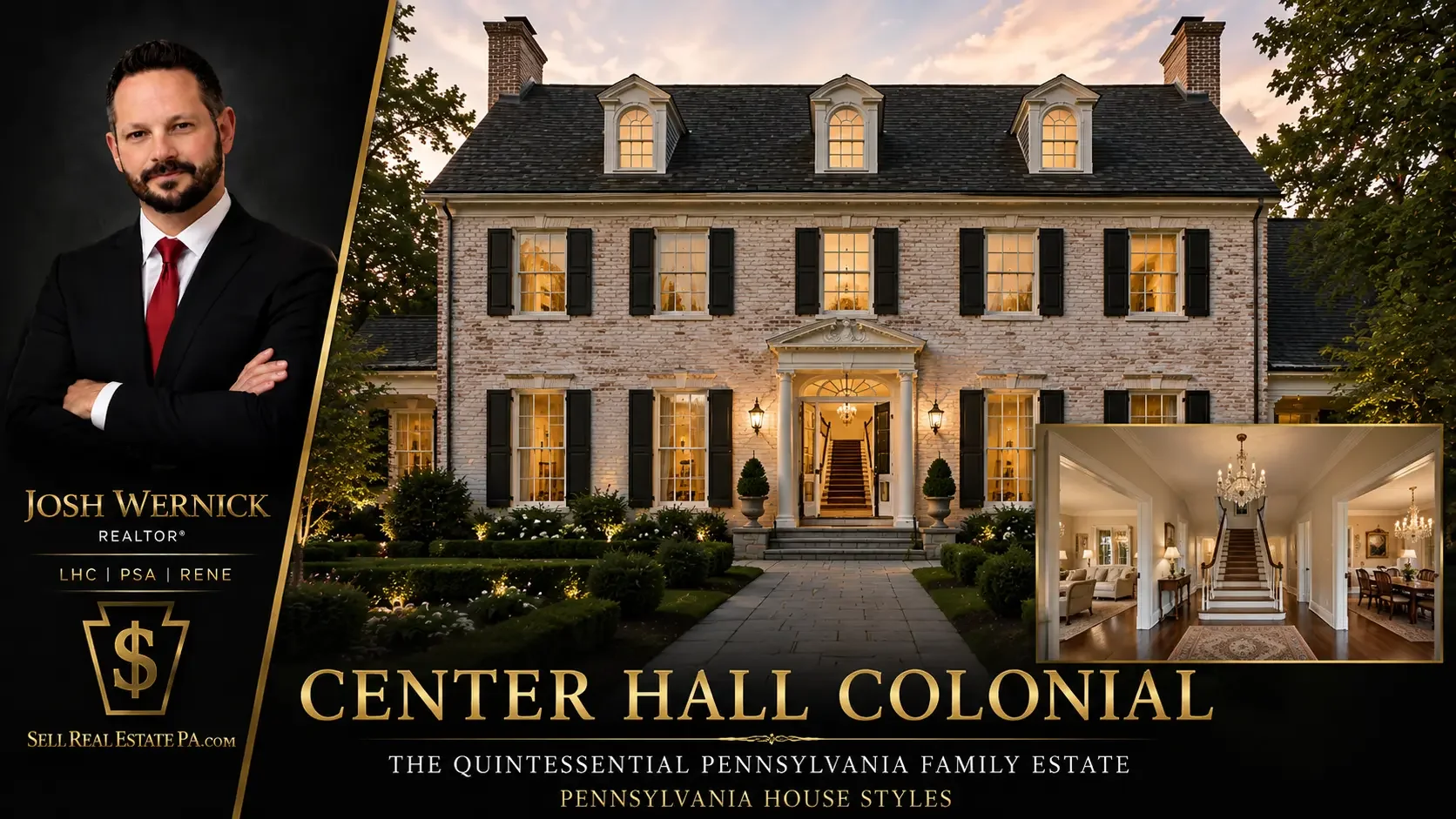
Center Hall Colonial
A specific variant of the colonial where the front entry opens directly into a central hallway with formal rooms on either side — living room to one side, dining room to the other — and a staircase rising from the center hall. The defining characteristic is the symmetry that extends from the exterior all the way through the interior layout.
Defining features: True center hall entry, formal symmetry inside and out, staircase at the center of the home, formal living and dining rooms flanking the entry.
Most common in: Established neighborhoods throughout Doylestown, Newtown, Blue Bell, Fort Washington, Wayne, and the Main Line communities where larger lots and more formal residential character predominate.
Pennsylvania Stone Colonial
A regional variant that defines Bucks County real estate more than any other style. Built of local fieldstone — quarried from Pennsylvania's landscape — these homes range from modest farmhouses to substantial estates. The stone gives them a permanence and character that frame construction cannot replicate. Age ranges from 18th century to mid-20th century, with reproductions built through the present day.
Defining features: Fieldstone exterior walls, thick walls creating deep window wells, often irregular footprint reflecting additions over generations, small-paned windows in older examples, steep rooflines.
Most common in: New Hope, Solebury Township, Doylestown Borough, Buckingham Township, Washington Crossing, Upper Makefield, New Britain, Chalfont, and throughout rural and semi-rural Bucks County. Also present in historic sections of Montgomery County including Lower Gwynedd, Gwynedd Valley, and Ambler.
This is the style that defines premium Bucks County real estate. A well-preserved stone colonial in Solebury Township or New Hope commands a significant premium over comparable frame construction in the same school district.

Split Level
The split level was the dominant new construction style across suburban Philadelphia from the mid-1950s through the mid-1970s. The defining characteristic is three offset floor levels — typically a main level with living room and kitchen, a half-flight up to bedrooms, and a half-flight down to a family room and garage. The exterior reflects this staggered interior with a facade that steps up on one side.
Defining features: Three offset levels accessible by short half-flights of stairs, no full story between levels, exterior facade that steps or staggers horizontally, typically attached garage at the lowest level.
Most common in: Warminster, Warrington, Horsham, Lansdale, Hatboro, Willow Grove, Abington, Cheltenham, and throughout the residential subdivisions built across both counties in the 1955-1975 era. Exceptionally common throughout the inner ring of Montgomery County suburbs.

Split Foyer
Frequently confused with the split level but structurally distinct. The split foyer's defining feature is the entry at mid-level — when you open the front door you stand between two half-flights, one going up to the main living level and one going down to the lower level. The exterior often resembles a two-story colonial but the interior is organized around that mid-level entry.
Defining features: Entry door at mid-level between floors, half-flight up to living areas and half-flight down to lower level, exterior often indistinguishable from colonial without seeing the entry.
Most common in: Similar suburban neighborhoods to the split level — Warminster, Warrington, Horsham, Hatboro, North Wales, and throughout Montgomery County's 1960s-1980s residential developments.

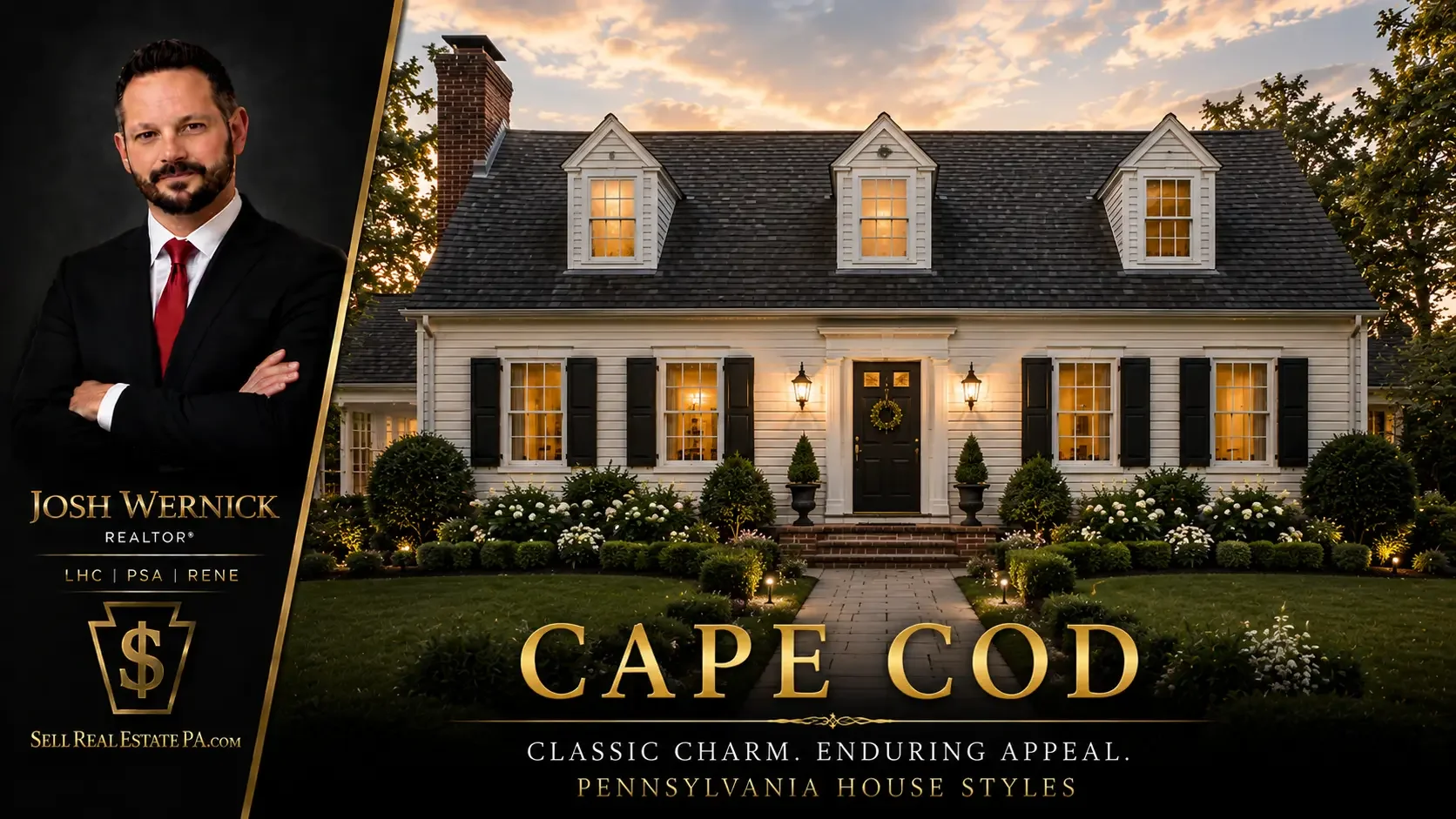
Cape Cod
The Cape Cod is one of the oldest American residential styles and one of the most common in the older residential neighborhoods throughout Bucks and Montgomery County. The defining characteristic is the steep, simple roofline that comes close to the first-floor walls — creating a 1.5-story home where the upper level is built into the attic space, often with dormers added to create usable headroom. Cape Cods built in the 1940s and 1950s are common throughout the region's older neighborhoods.
Defining features: Steep side-gabled roof with minimal eave overhang, 1.5 stories, dormers on the upper level, centered front door, symmetrical facade, typically modest footprint.
Most common in: Hatboro, Lansdale, North Wales, Ambler, Jenkintown, Abington, Cheltenham, and throughout the older residential neighborhoods in both counties. Also present in older sections of Doylestown Borough, New Hope Borough, and Newtown Borough.
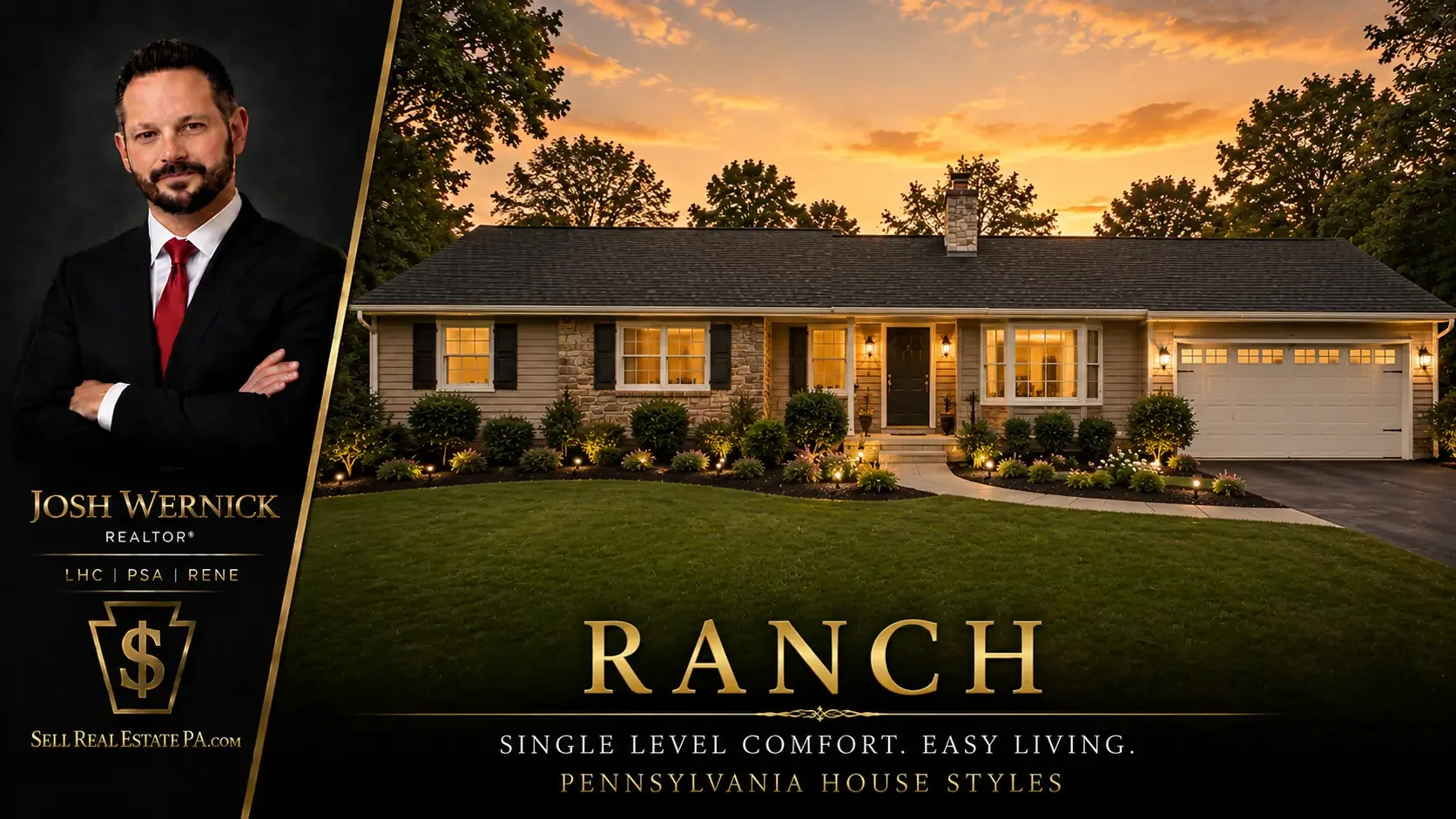
Ranch
The ranch house is a single-story home with a horizontal emphasis — wider than it is tall, with all living space on one level and typically no stairs for interior access. Built predominantly in the 1950s and 1960s, ranches are common throughout the region's early postwar suburban developments. Their single-story layout makes them particularly attractive to downsizers and buyers with mobility considerations.
Defining features: Single story, horizontal footprint, low-pitched roof, attached garage typically at one end, all living space on one level.
Most common in: Lansdale, Hatfield, North Wales, Horsham, Warminster, Warrington, and throughout the earliest postwar residential developments in both counties. Also present in older sections of lower Bucks County communities including Langhorne and Bensalem.
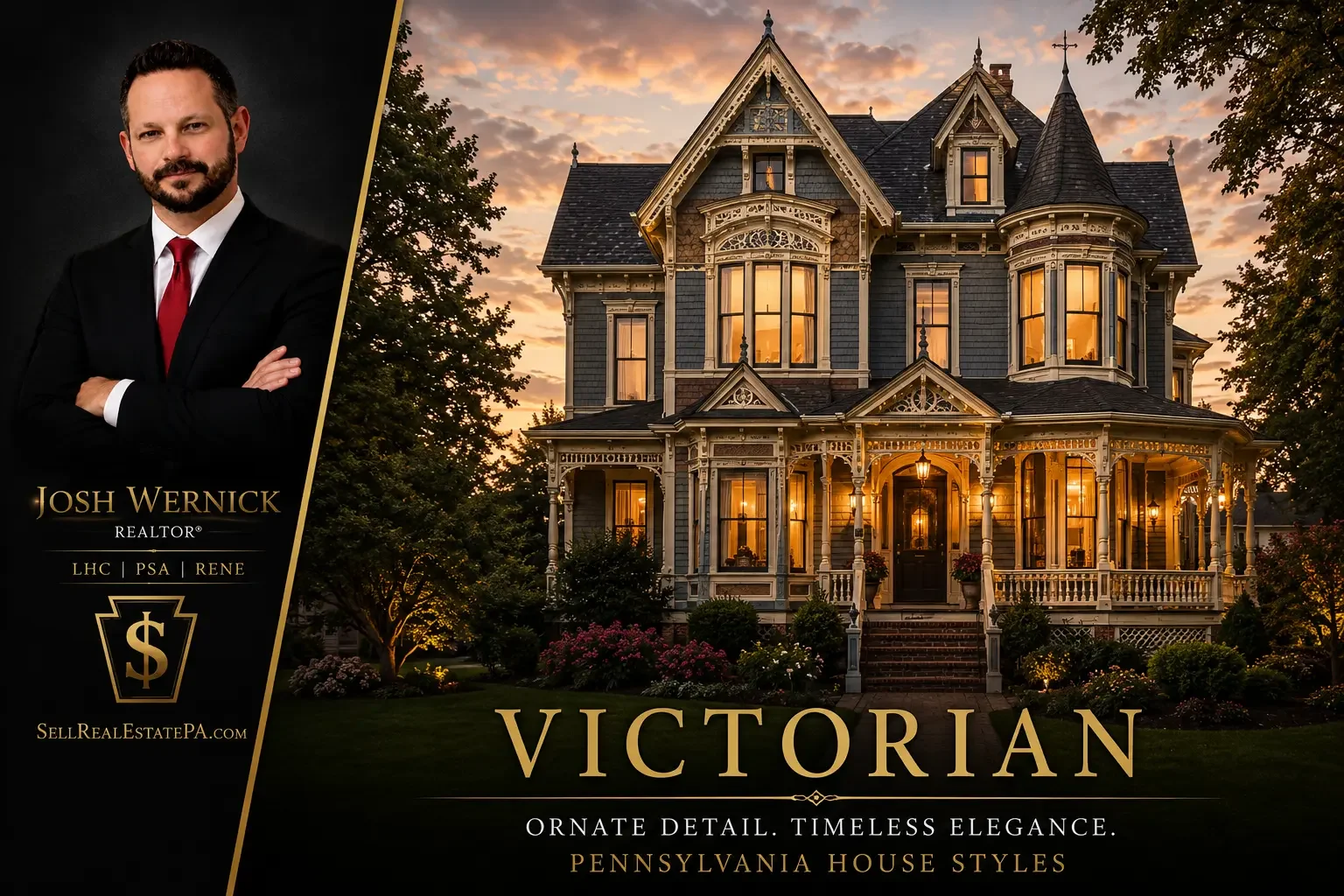
Victorian
Victorian architecture — built from roughly 1860 through 1910 — is characterized by ornate decorative detail, asymmetrical facades, steeply pitched rooflines, wraparound or decorative porches, bay windows, and a general exuberance of architectural character that later styles deliberately rejected. Victorian homes in southeastern Pennsylvania are concentrated in the older boroughs and walkable communities that predated the automobile suburb.
Defining features: Ornate decorative trim and millwork, asymmetrical facade, steeply pitched rooflines often with towers or turrets, wraparound porches, bay windows, decorative gable ends.
Most common in: Ambler Borough, Jenkintown Borough, Hatboro Borough, Lansdale Borough, North Wales Borough, Doylestown Borough, New Hope Borough, Chestnut Hill, and throughout the older sections of communities with pre-automobile development patterns. Lower Merion Township's older neighborhoods including Ardmore and Narberth also host significant Victorian stock.
Tudor Revival
The Tudor Revival style brings English medieval architectural elements to American residential construction — most prominently the half-timbering that creates the distinctive pattern of dark wood beams against light stucco on the facade. Steeply pitched rooflines, prominent chimneys, arched doorways, and multi-paned windows complete the look. Tudor Revival was most popular from roughly 1910 through the 1940s.
Defining features: Half-timbered facade with dark wood beams and light stucco, steeply pitched rooflines, prominent brick or stone chimneys, arched or rounded doorways, multi-paned casement windows, often stucco or stone on the lower level.
Most common in: Lower Merion Township — particularly Ardmore, Wynnewood, Merion Station, and Penn Valley — where Tudor Revival was the dominant style for the substantial homes built in the 1920s and 1930s. Also present throughout Chestnut Hill, the older sections of Wayne and Radnor Township, and established neighborhoods in Fort Washington and Wyndmoor.

Craftsman / Bungalow
The Craftsman style emerged as a reaction against Victorian excess — emphasizing simplicity, natural materials, and handcraft. The bungalow form — typically one or 1.5 stories with a broad front porch under a wide, low-pitched roof — is the most common Craftsman expression. Built predominantly from 1905 through the 1930s, Craftsman homes are concentrated in the walkable boroughs and older streetcar neighborhoods of the region.
Defining features: Low-pitched gabled roof with wide overhanging eaves and exposed rafter tails, broad front porch with tapered columns on stone or brick piers, natural materials including wood, stone, and brick, double-hung windows often in groups of three, built-in interior woodwork and cabinetry.
Most common in: Ambler Borough, Jenkintown Borough, Glenside, Wyncote, Cheltenham Township, Abington, and throughout the older walkable neighborhoods developed during the streetcar era. Also present in Chestnut Hill, Narberth, and the older sections of Wayne and Ardmore.

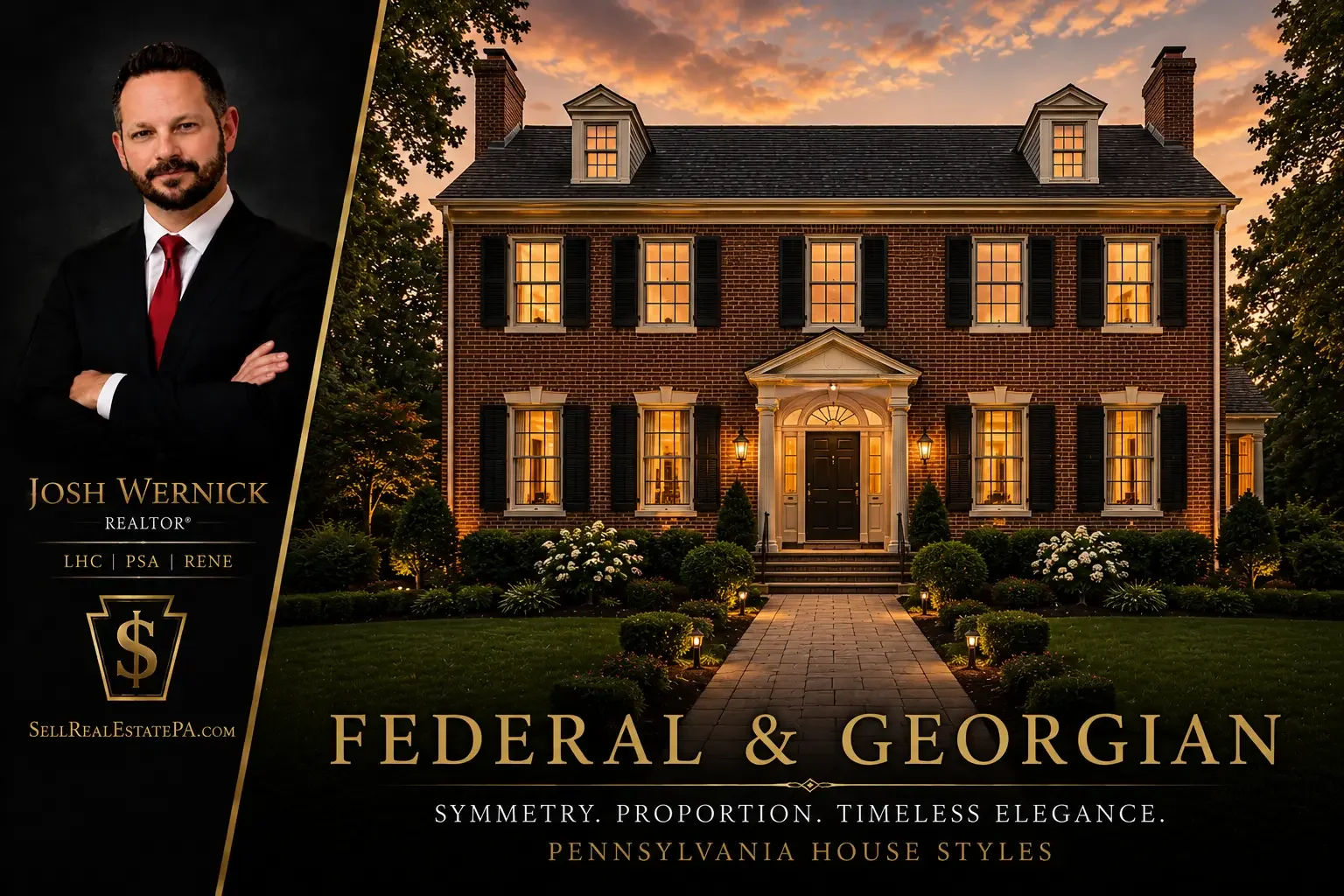
Federal and Georgian
The formal symmetry of Federal and Georgian architecture reflects the 18th and early 19th century English influence on American residential construction. These styles are characterized by strict bilateral symmetry, restrained ornamentation, fanlight windows above centered doorways, and brick construction. In southeastern Pennsylvania, genuine Federal and Georgian homes are historic properties — most dating from the late 1700s through the early 1800s.
Defining features: Strict bilateral symmetry, centered entry with fanlight or sidelights, brick construction, restrained ornamentation, five-bay facade in classic Georgian form, low-pitched hipped or gabled roof.
Most common in: Washington Crossing, New Hope, Newtown Borough, Doylestown Borough, and throughout the historic communities of Bucks County where 18th century construction survives. Also present in the historic cores of Lower Merion Township and the older sections of Germantown and Chestnut Hill.
Dutch Colonial
The Dutch Colonial is identified primarily by its gambrel roof — a roof with two slopes on each side, the lower slope steeper than the upper, creating a barn-like silhouette. This distinctive roofline creates additional headroom on the upper level and is often combined with dormers. Dutch Colonials were popular from the late 1800s through the 1930s.
Defining features: Gambrel roof with two distinct slopes per side, often with shed dormers across the front, typically two stories, centered or offset entry, colonial-style windows.
Most common in: Older residential neighborhoods throughout Montgomery County including Abington, Cheltenham, Lower Merion, and Fort Washington. Also present in the older sections of Bucks County boroughs including Lansdale, Doylestown, and Newtown.

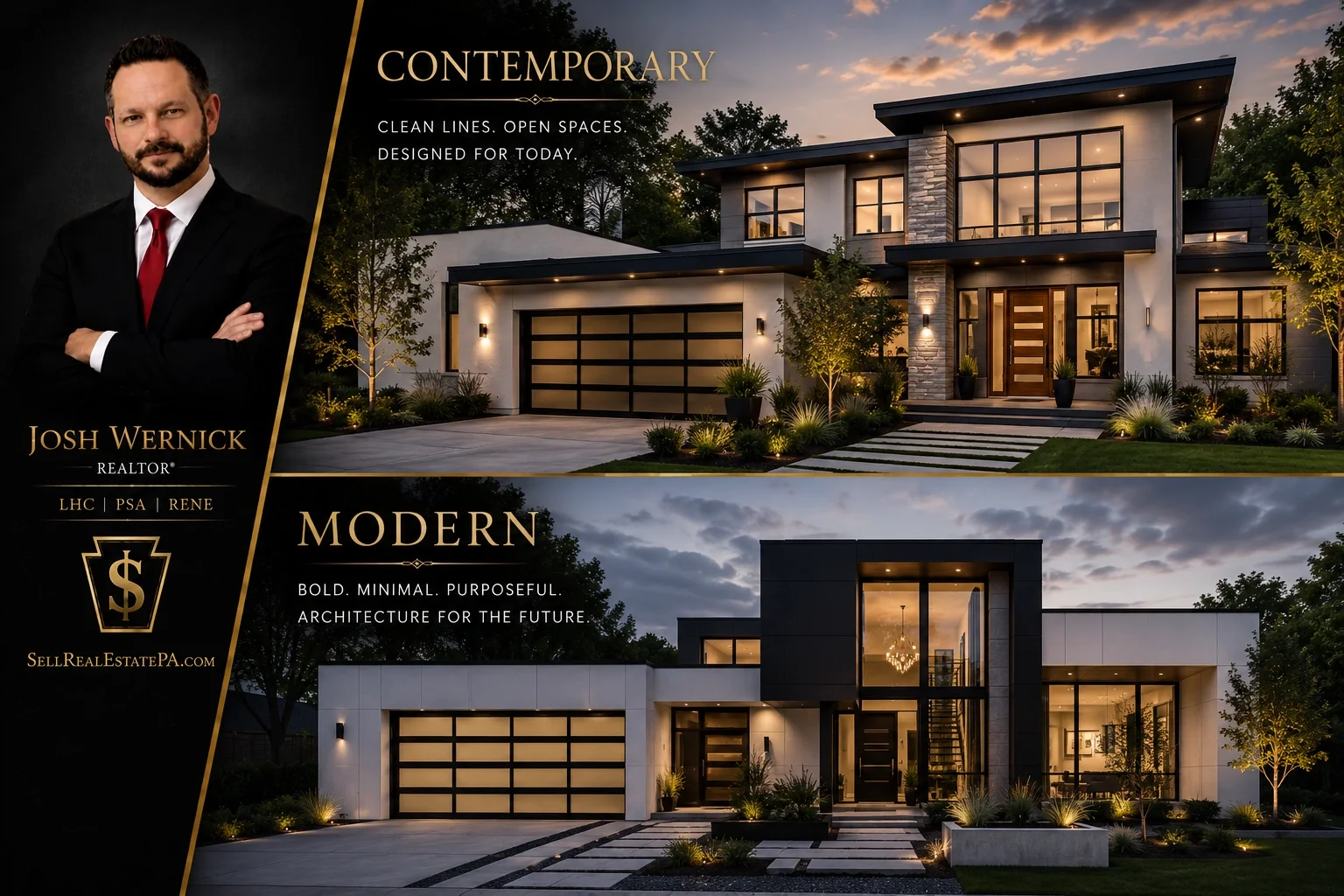
Contemporary and Modern
Contemporary residential architecture is defined more by what it lacks than what it has — the ornament, symmetry, and historical references of traditional styles are replaced by clean lines, large expanses of glass, open floor plans, and a deliberate integration of interior and exterior space. In Bucks County and Montgomery County, true contemporary and modern homes are relatively uncommon but present in pockets of new construction and custom building.
Defining features: Flat or low-pitched rooflines, large windows and glass walls, open interior floor plans, non-traditional massing, integration of natural materials, minimal exterior ornamentation.
Most common in: New construction in Solebury Township and New Hope where buyers specifically seek contemporary design in a historic landscape. Also present in custom construction throughout Buckingham Township and the more rural sections of upper Bucks County. Scattered examples throughout Montgomery County custom construction.
Bi-Level
The bi-level is a two-story home with the entry at grade — when you enter, you stand at a landing between two half-flights, one going up to the main living level and one going down. Unlike the split foyer, the bi-level typically has a more traditional two-story exterior appearance with the lower level partially below grade. Frequently confused with split levels and split folios in MLS listings.
Defining features: Entry at grade between two half-flights, main living level above grade, lower level partially below grade, exterior typically appears as two-story construction, garage often at lower level.
Most common in: Similar to split levels — Warminster, Warrington, Horsham, Hatfield, Lansdale, and throughout the suburban residential developments of the 1960s and 1970s in both counties.

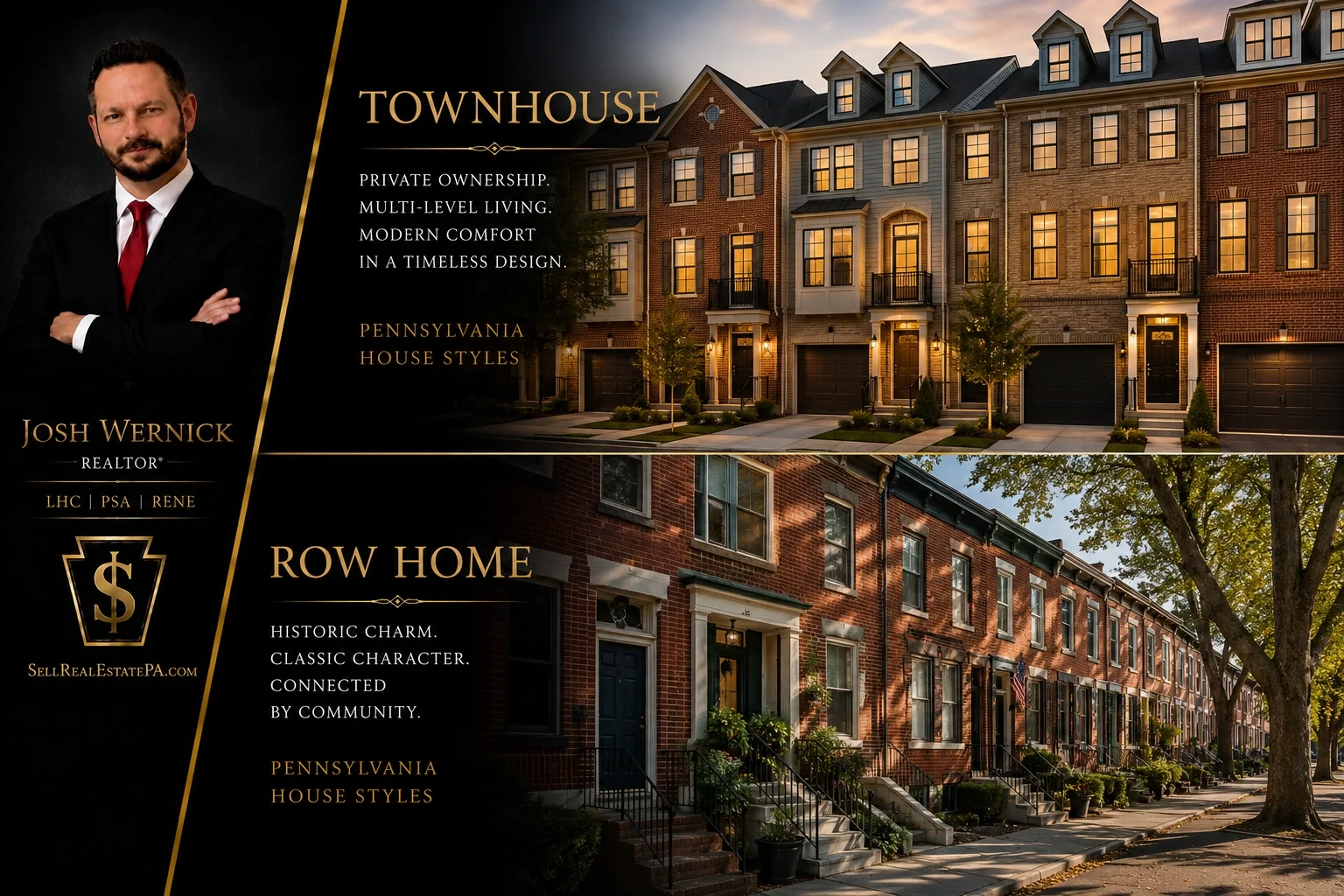
Townhouse and Rowhome
Attached residential construction — where the home shares one or both side walls with adjacent units — encompasses everything from historic rowhomes in older boroughs to modern luxury townhouse communities. The distinction between a townhouse and a rowhome is primarily one of era and context: rowhomes are the attached brick construction of older urban neighborhoods, while townhouses are the attached or semi-detached construction of modern planned communities.
Defining features: Shared side walls with adjacent units, typically two or three stories, individual front entries, often with small rear yards or patios, parking in attached garage or designated spaces.
Most common in: Townhouse communities are concentrated throughout Lansdale, North Wales, Montgomeryville, Warrington, Horsham, Newtown Township, and throughout both counties wherever planned residential communities were developed from the 1980s through the present. Historic rowhomes are present in Ambler Borough, Lansdale Borough, Jenkintown, Cheltenham, and Abington.
Not Sure What Style Your House Is?
If you're preparing to list your home in Bucks County, Montgomery County, the Main Line, or Chestnut Hill and you're not certain how to describe the architectural style — or you want to know how the style affects your pricing and buyer pool — that's a conversation worth having before you list.
Call or text Josh Wernick - REALTOR® at 267-934-5674
Luxury Homes Certified · Pricing Strategy Advisor · Real Estate Negotiation Expert
Free home value analysis, no pressure, no obligation.
Home Styles in Bucks and Montgomery County PA FAQ
What is the most common house style in Bucks County PA?
The colonial is the most common residential style in Bucks County by a significant margin, followed by split levels from the 1960s-1970s era and ranch homes from the 1950s-1960s. Pennsylvania stone colonials are the most distinctive and highest-value style in Bucks County, concentrated in New Hope, Solebury Township, Doylestown, and Buckingham Township.
What is the most common house style in Montgomery County PA?
Colonials, split levels, and cape cods dominate Montgomery County's housing stock. Tudor Revival homes are particularly prevalent in Lower Merion Township from the 1920s-1930s era. Ranch homes from the 1950s-1960s are common throughout the northern Montgomery County suburbs including Lansdale, Horsham, and Hatfield.
What architectural styles are most common on the Main Line PA?
The Main Line features the full range of regional styles but with a concentration of Tudor Revival from the 1920s-1940s in Lower Merion Township, Victorian homes in the walkable boroughs like Narberth and Ardmore, stone colonials throughout the older sections of Wayne and Radnor Township, and significant colonial construction from the postwar era throughout Tredyffrin-Easttown communities including Berwyn and Devon.
What house styles are common in Chestnut Hill PA?
Chestnut Hill is dominated by Victorian, Arts and Crafts, Craftsman, and Tudor Revival architecture from the late 19th and early 20th century development of the neighborhood. The Germantown Avenue corridor anchors a community of historic homes that attract buyers specifically seeking architectural character unavailable in newer suburban construction.
Does the architectural style of my house affect its value in Pennsylvania?
Yes — significantly in some cases. Pennsylvania stone colonials command a premium in Bucks County's historic communities. Tudor Revival homes in Lower Merion Township attract buyers willing to pay for architectural character. Victorian homes in walkable boroughs like Ambler and Jenkintown attract buyers who specifically target that era. Understanding how your home's style positions it within its specific submarket is part of accurate pricing strategy.