

Divorce Buyout vs. Selling the House in Pennsylvania: Which Option Is Right for You?

When you’re dividing the marital home in a Pennsylvania divorce, two options come up more than any other: one spouse buys out the other and keeps the house, or you sell and split the proceeds. Both are legitimate paths. One of them is almost always clearly better for your specific situation -- and most people don’t know which one until they run the actual numbers.
I am a licensed Pennsylvania REALTOR and RREDS-certified Residential Real Estate Divorce Specialist. I help divorcing homeowners in Bucks County, Montgomery County, the Main Line, and Chestnut Hill figure out which option works -- and execute whichever one they choose.
The Core Question: What Is the House Actually Worth?
Before you can evaluate a buyout or a sale, you need an accurate current market value. Not a Zestimate. Not what your neighbor got two years ago. Not what your spouse’s attorney says it’s worth. A current market analysis from a licensed agent who sells in your specific market.
In Bucks County and Montgomery County right now, home values vary significantly by municipality, school district, and street. A Doylestown Borough colonial and a Warminster split-level are not the same market. The number that goes into your divorce agreement needs to reflect the actual current market -- because it determines the buyout amount, the equity split, and the tax consequences.
Text your address to 267-934-5674. I will provide a current market analysis within 24 hours at no charge.
Option 1: The Buyout
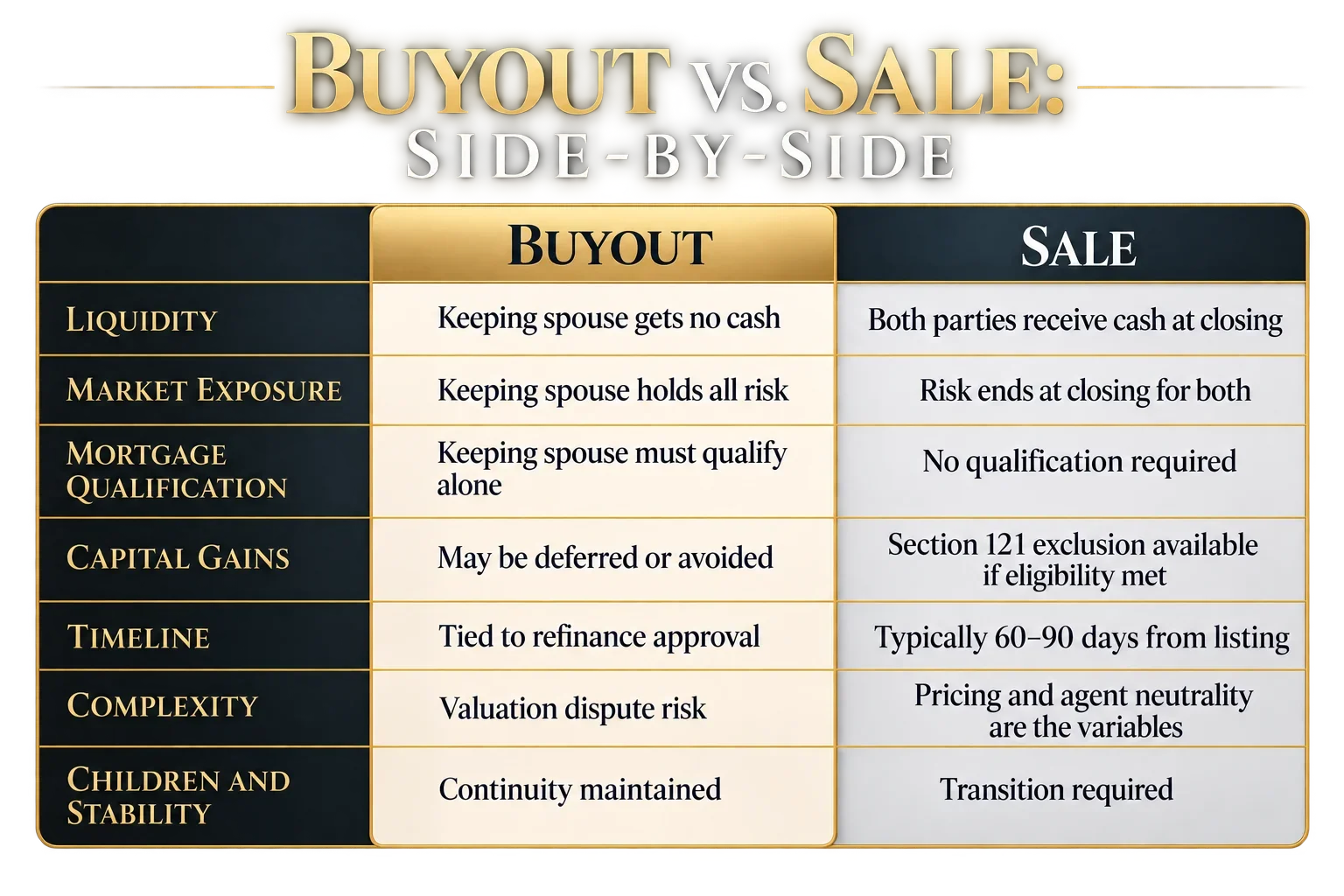
One spouse pays the other their share of the equity and keeps the house. Typically accomplished by refinancing the mortgage in the keeping spouse’s name alone -- which removes the other spouse from the loan obligation -- and using cash-out proceeds or other assets to fund the equity payment.
When a buyout makes sense:
Children are in school and stability matters more than liquidity right now
The keeping spouse qualifies for a mortgage on their income alone at current rates
The home has appreciated significantly and selling triggers a capital gains conversation the parties want to avoid or manage
One spouse has genuine emotional attachment to the property and the numbers support keeping it
What a buyout actually requires:
The keeping spouse must qualify for a new mortgage based on their individual income, credit, and debt load -- not the household’s combined income. In the current rate environment, that qualification can look very different from when the original mortgage was written. A keeping spouse who qualified for a $600,000 mortgage at 3% in 2021 may qualify for substantially less at today’s rates. This matters before agreeing to a buyout -- not after.
The buyout amount is based on the agreed-upon market value minus the mortgage payoff and selling costs. The “selling costs” piece is important: even in a buyout, equity is typically calculated net of what a hypothetical sale would have cost -- commissions, transfer taxes, closing costs -- so the keeping spouse isn’t paying the departing spouse as if the home sold when it didn’t. This is a negotiation point your attorney handles, but it affects the number significantly on a Bucks County or Main Line property.
The risk in a buyout:
The keeping spouse takes on the full market exposure. If values decline, they absorb the loss alone. If they need to sell in three years because circumstances changed, they bear the full transaction cost at that point. And if they cannot ultimately qualify for the refinance -- which happens -- the deal falls apart after both parties have built their financial plans around it.
Option 2: Sell and Split
The home is listed, sold at market value, and the net proceeds are divided per the divorce agreement. Both parties receive their equity share in cash and neither carries a joint asset or joint mortgage obligation forward.
When selling makes sense:
Neither spouse can comfortably carry the mortgage on their income alone
Both parties need liquidity to fund separate households, legal fees, or new living situations
The home requires significant deferred maintenance that neither party wants to manage
The parties cannot agree on a buyout value and litigation over the valuation would cost more than it’s worth
The Section 121 capital gains exclusion window is still open for both parties and the tax math favors selling now
What a sale actually produces:
In the current Bucks County and Montgomery County market, correctly priced homes are moving. The proceeds from a well-executed sale -- priced at current market value, prepared properly, and listed with an agent who understands the local market -- are real money. On a home that has appreciated from a 2015 or 2018 purchase price, the equity available after payoff is often the largest single asset in the divorce.
The variable is execution. An agent who prices low to get a fast close serves one party. An agent who prices high to placate the spouse who wants more time serves neither. A neutral agent whose only interest is the correct market price is what both parties need.
The Section 121 Capital Gains Exclusion -- Read This Before You Decide
Each spouse can exclude up to $250,000 in capital gains from the sale of a primary residence -- but only if they have lived in the home for at least 2 of the last 5 years. The clock runs from the date each spouse last lived there, not from when the divorce is finalized.
If one spouse moved out three years ago, their exclusion window may already be closed. On a Montgomery County or Main Line home that has appreciated $400,000 since purchase, a lost exclusion is a $90,000+ federal tax consequence at capital gains rates. That number changes the math on whether a buyout or a sale makes more financial sense -- and it needs to be modeled by your CPA before the settlement is finalized, not after.
This is one of the most commonly missed considerations in Pennsylvania divorce real estate settlements. Attorneys negotiate equity splits. CPAs handle tax. The gap between them -- the timing of the sale relative to each spouse’s residency window -- often goes unaddressed until it’s too late to fix.
One Piece Most People Miss: The Appraisal vs. Market Analysis Question
In a buyout, the value is typically set by appraisal -- ordered by the court or agreed to by the parties. In a sale, the market sets the value. These two numbers are not always the same, and the difference matters.
A licensed appraisal is a point-in-time opinion by a certified appraiser. A current market analysis from an active listing agent reflects what buyers are actually paying right now in your specific submarket. In a rising market, an appraisal can lag actual sale prices by 60 to 90 days. In a declining market, it can work the other direction.
Before agreeing to a buyout price based on an appraisal, both parties benefit from a current market analysis from an agent active in that specific area. If the appraisal and the market analysis diverge significantly, that is a conversation worth having with your attorney before the agreement is signed.
Divorce Buyout vs. Selling the House in Pennsylvania - FAQ
Is a buyout or selling better in a Pennsylvania divorce?
It depends on three variables: whether the keeping spouse qualifies for a mortgage on their own, whether the Section 121 capital gains exclusion is still available for both parties, and whether the agreed-upon value accurately reflects the current market. There is no universal answer -- but running the actual numbers on both scenarios takes 24 hours and costs nothing. Text 267-934-5674.
How is the buyout amount calculated in a Pennsylvania divorce?
Agreed market value minus the mortgage payoff minus estimated selling costs (typically 6-8% of sale price for commissions, transfer taxes, and closing costs), divided per the settlement agreement. The deduction of hypothetical selling costs is standard but negotiable -- your attorney handles this. The market value input is where a current market analysis matters most.
Can one spouse be forced to accept a buyout in Pennsylvania?
No. A buyout requires both parties to agree on value and terms. If the parties cannot agree, the court can order a sale -- it cannot force one spouse to take a buyout the other proposes. A court-ordered sale is the endpoint when negotiation fails, not a court-ordered buyout.
What if we can’t agree on what the house is worth?
The court can order an appraisal, or each party can commission their own and the court resolves the dispute. In practice, most valuations are resolved through negotiation -- and a current market analysis from a neutral, licensed agent active in your specific market gives both parties a defensible starting point. Text 267-934-5674 for a no-obligation market analysis.
Does the keeping spouse have to refinance immediately in a Pennsylvania divorce?
Not always -- but they should. Carrying a joint mortgage after divorce means both parties remain legally obligated on the debt. If the keeping spouse misses a payment, the departing spouse’s credit is affected. Most divorce agreements require refinancing within a set period -- 6 to 12 months is common -- but the sooner the keeping spouse refinances and removes the other party from the obligation, the cleaner the separation.
How long does a divorce home sale take in Pennsylvania?
From listing to closing, a correctly priced Bucks County or Montgomery County home typically moves in 60-90 days in the current market. The variable is the pre-listing period -- getting both parties to agree to list, sign the listing agreement, and prepare the home for sale. With cooperative parties and attorneys, that can happen in two to three weeks. In contentious situations, it takes longer.
Should I use one agent or two in a divorce home sale?
One. Two agents -- one for each spouse -- creates a built-in conflict of interest. Each agent’s commission depends on the sale, so each has an incentive to keep the transaction moving, but each also has a client relationship with one party. That structure produces delays, miscommunication, and frequently worse outcomes for both parties. One neutral, RREDS-certified agent managing the transaction is the standard approach.
Who should I hire for a divorce home sale in Pennsylvania?
An agent who is RREDS-certified, neutral, and experienced coordinating with family law attorneys on both sides. Josh Wernick serves divorcing homeowners in Bucks County, Montgomery County, the Main Line, and Chestnut Hill. Text 267-934-5674 for a confidential consultation.
Related Pages:
Selling a house during divorce in Pennsylvania
What happens to the house in a divorce in Pennsylvania
Selling a house during divorce in Bucks County
Selling a house during divorce in Montgomery County
Selling a house during divorce on the Main Line
Selling a house during divorce in Chestnut Hill