

Is My House a Mansion or a McMansion?
The question homeowners ask but rarely get an honest answer to — and why it matters enormously when you go to sell.
The Honest Difference — Side by Side


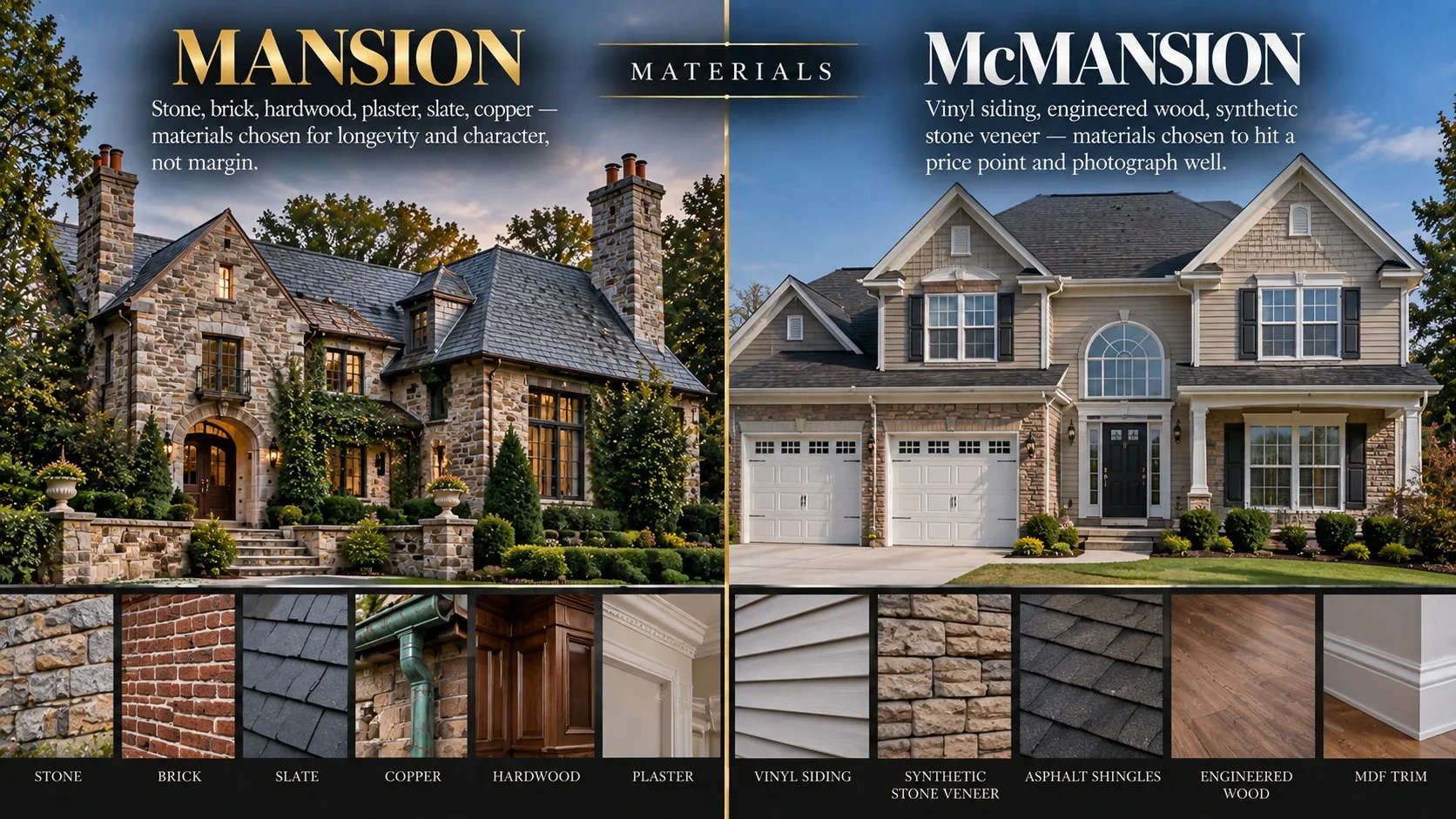


The Square Footage Trap
The most common misconception about mansions and McMansions is that the difference is square footage. It is not. A 6,000 square foot production home on a 0.3-acre lot in a subdivision of identical 6,000 square foot production homes is a McMansion. A 3,800 square foot custom home on 2 private acres with original architectural details and materials that cannot be replicated is an estate. Square footage is a data point. It is not an indicator of quality character or ultimate value.
The McMansion was built to impress on first visit. High ceilings in the entry. Granite everywhere. The two-story great room with the gas fireplace visible from the front door. Every detail designed to photograph well and sell quickly. None of it designed for the person who is going to live there for twenty years. The mansion was built for the person who was going to live there for twenty years — and it shows in every decision made during construction.
The price per square foot problem: McMansions trade on price per square foot because that is the only metric that makes them look competitive. The buyer who shops on price per square foot is the McMansion's natural buyer. The buyer who understands what makes a property genuinely rare — the lot the privacy the materials the craftsmanship the irreplaceable character — stops counting square footage and starts asking different questions. If you have to justify your home's price with square footage you are probably not selling a mansion.
Is Your Home a Mansion or a McMansion? The Checklist.
◆ Was it custom designed or production built?
Custom designed for your lot by an architect who considered the site — mansion signal. Catalog floor plan selected from a builder's options book — McMansion signal. David Cutler, Toll Brothers, NV Homes — production builders. Individually commissioned architecture — estate builder.
◆ What is the lot-to-structure ratio?
A home that sits appropriately on its lot with privacy setbacks and room to breathe is an estate. A home that fills its lot to the building envelope with neighbors close on all three sides is a production home regardless of how many square feet it contains.
◆ What backs the property?
Permanently preserved open space, a working farm that is not for sale, mature woodland, or a body of water — estate signal. Another row of identical houses, a road, a commercial property, or a fence between you and the neighbor — McMansion signal. What is permanently behind the property is one of the most important pricing variables in residential real estate and almost nobody talks about it directly.
◆ What are the primary exterior materials?
Natural stone, brick, real stucco, slate — materials that age with character. Vinyl siding, manufactured stone veneer, synthetic stucco applied over foam — materials that age with maintenance costs and aesthetic decline. The exterior material is the most visible statement of what a home is made of.
◆ Are the architectural elements proportional and consistent?
Every window sized in proportion to the wall it sits in. Rooflines that make structural sense. Columns that support something. Details that are consistent from the front of the home to the back — estate signal. Decorative columns that support nothing, rooflines added for visual complexity, architectural details on the front elevation that disappear on the sides and rear — McMansion signal.
◆ How many of your neighbors have the same house?
If you can drive two streets over and find your floor plan — McMansion. If your home is genuinely singular in its specific combination of lot, architecture, materials, and setting — estate. The interchangeability of a production home is not just an aesthetic observation. It directly determines how many comparable sales exist when it is time to price your home.
◆ Who is the buyer for your home?
If the buyer is comparison shopping on price per square foot against similar homes in similar neighborhoods — McMansion buyer dynamic. If the buyer has been looking for this specific property — this lot, this setting, this privacy, this character — and there is nothing else like it available — estate buyer dynamic. The buyer who cannot be substituted is the buyer who pays the price the property deserves.
Why This Matters When You Sell
A true estate and a McMansion sell completely differently and require completely different strategies. The McMansion competes on price per square foot against comparable production homes in the same price tier. The right strategy is aggressive pricing at the bottom of the range to generate competition from buyers who are shopping the tier. The estate has no direct comparables. The right buyer has been looking for this specific combination of features and will pay accordingly when they find it.
The pricing error most sellers of genuine estates make is allowing their agent to price them against comparable square footage in comparable zip codes — which means they are pricing against McMansions. Their home is not a McMansion. It should not be priced like one. And it should not be marketed like one.
The marketing error is equally common. A true estate needs to reach the specific buyer who has been waiting for it — not be blasted at every buyer in the price range. That specific buyer may be a corporate relocation buyer. A physician or attorney who has been looking for the right private property for two years. A buyer from New York or New Jersey who has identified this corridor specifically. Reaching that buyer requires distribution that goes beyond the standard MLS listing and a presentation that communicates immediately what makes the property different.
The McMansion Reality
What You Are Actually Selling When You Are Selling a McMansion
Six thousand square feet on a third of an acre. The same floor plan as fourteen other homes in the subdivision. Synthetic stone veneer on the front elevation, vinyl on the sides and rear. Hollow-core doors. Two-story entry that looks stunning on first visit and costs a fortune to heat. Neighbors whose kitchen windows face your primary bedroom. A comp pool of every similar production home in a three-mile radius. The buyer who shops on price per square foot. A pricing strategy that is entirely dependent on what everyone else sold for. This is not a criticism — it is a description. Knowing what you have is the first step to selling it correctly.
Not sure what you have? Call and find out.
267-934-5674 joshwernick@kw.com
· Josh Wernick - REALTOR® · Keller Williams Real Estate · Named 2026 Top Agent Bucks County and Montgomery County — BestAgents.us · Free home value analysis · No obligation
Is My House a Mansion or a McMansion? - Frequently Asked Questions
What is the difference between a mansion and a McMansion?
A mansion is custom designed for a specific owner on a specific site with quality materials chosen for longevity and character. A McMansion is a production builder home — large square footage from a catalog floor plan, synthetic materials, maximum house on minimum lot. The difference is not size. It is origin, materials, craftsmanship, lot relationship, and the degree to which the home is interchangeable with others like it.
Does square footage determine whether a home is a mansion?
No. Square footage is the most misleading metric in luxury residential real estate. A 6,000 square foot production home on a 0.3-acre subdivision lot is a McMansion. A 3,800 square foot custom estate on 2 private acres with irreplaceable materials and setting is a true estate. The buyer who understands the difference stops counting square footage and starts asking about lot, setting, materials, craftsmanship, and what makes the property singular.
Why does it matter whether my home is a mansion or McMansion when I sell?
Because they require completely different pricing and marketing strategies. The McMansion competes on price per square foot against a large pool of similar homes. The true estate has no direct comparables and should not be priced against them. The right buyer for a genuine estate has been specifically looking for that combination of features and will pay accordingly. The wrong strategy applies McMansion pricing to an estate and leaves money on the table.
How do I know if my home is a true estate or a production builder home?
Ask whether it was custom designed by an architect for your specific lot or selected from a production builder's floor plan catalog. Look at what backs the property — permanent privacy or neighbors. Count how many similar homes exist within a mile. Examine the materials — natural stone and hardwood or synthetic veneer and engineered wood. The answers tell you immediately what category your home falls into. Call 267-934-5674 for an honest assessment.
Are there true estate properties for sale in Bucks County and Montgomery County PA?
Yes — and they are rare. Fewer than 2,450 detached homes will sell across Bucks and Montgomery County for the remainder of 2026. True estates — custom homes on private lots with irreplaceable settings — represent a fraction of that already-constrained inventory. When one comes to market the buyer who has been waiting for it moves quickly. Call 267-934-5674 for current estate opportunities in the region.