

How to Avoid a Sheriff's Sale in Pennsylvania
There are six ways to avoid a Pennsylvania sheriff's sale. Five require time. One works even the week before the sale date.
Which option is right for you depends on how much time you have, how much equity you have, and whether you want to keep the property or exit it. This page covers all six in plain terms.
Behind on your mortgage in Bucks or Montgomery County?
Call or text 267-934-5674 — I will tell you what your home is worth within 24 hours. That number determines which options are available to you. Confidential. No pressure.
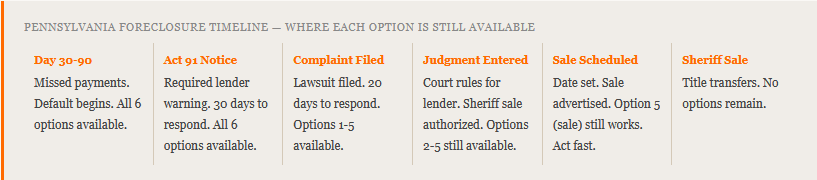
Where You Are in the Pennsylvania Foreclosure Timeline
Before you can evaluate any option you need to know where you are in the process. Pennsylvania is a judicial foreclosure state — the bank must sue you and win a court judgment before a sheriff sale can occur. That process takes time. The earlier you act, the more options you have.
The Six Options to Avoid a Sheriff's Sale
Option 1 — Loan Modification Keep the Home
A loan modification changes the terms of your existing mortgage — reducing the interest rate, extending the loan term, adding missed payments to the back of the loan, or a combination. The goal is to produce a monthly payment you can afford going forward. You keep the home. The foreclosure process pauses while a complete modification application is under review.
Loan modifications are negotiated directly with your lender or their loan servicer. Most servicers have a loss mitigation department specifically for this. You will need to document your financial hardship, income, expenses, and assets. The process takes weeks to months. A HUD-approved housing counselor can navigate this process with you at no cost.
Pennsylvania's Act 91 notice — which the lender must send before filing a foreclosure lawsuit — specifically informs you of your right to apply for mortgage assistance through the Pennsylvania Housing Finance Agency (PHFA). That is the starting point for the modification conversation.
Requires: Documented financial hardship. Proof of income sufficient to support a modified payment. Time — apply as early as possible, not after a judgment is entered. Works best in the earlier stages of the foreclosure timeline.
Option 2 — Forbearance Agreement Keep the Home
A forbearance agreement is a temporary pause or reduction in your mortgage payments for a defined period — typically three to twelve months. At the end of the forbearance period, the missed payments must be repaid, either as a lump sum, added to the loan balance, or spread over future payments through a repayment plan. Forbearance is not forgiveness. It is a delay that gives you time to resolve the underlying financial hardship.
Forbearance makes sense when your financial hardship is temporary — a job loss, a medical event, a divorce — and you expect to resume regular payments within a foreseeable period. It does not make sense if you do not have a realistic path back to making payments when the forbearance period ends, because you will face the same situation plus the accumulated balance.
Requires: Lender agreement. Documentation of temporary hardship. A realistic plan for resuming payments at the end of the forbearance period. Most effective when used very early in the default timeline.
Option 3 — Reinstatement Keep the Home
Reinstatement means paying the entire past-due amount — all missed payments, late fees, attorney fees, and other costs the lender has accumulated — in a single payment. This brings the loan current and stops the foreclosure process entirely. It is the cleanest option when the funds are available.
In Pennsylvania, you have the right to reinstate the loan up to one hour before the sheriff sale begins. This right is statutory. If you can access the funds — from family, from an asset sale, from a refinance, from any source — reinstatement is available until the last possible moment.
The reinstatement amount includes more than just missed payments. The lender's attorney fees, court costs, title search fees, and other default-related charges accumulate throughout the foreclosure process and must be paid in full. Get the exact reinstatement amount in writing from your lender's attorney before attempting to reinstate.
Requires: Full lump-sum payment of all amounts due including accumulated fees. Available in Pennsylvania up to one hour before the sheriff sale. Most practical when the missed payment amount is manageable relative to available resources.
Option 4 — Bankruptcy Filing Delay and Restructure
Filing for bankruptcy triggers an automatic stay — a federal court order that immediately halts all collection actions including sheriff sales. The moment a bankruptcy petition is filed, a scheduled sheriff sale must stop. This is one of the most powerful tools available to a homeowner facing an imminent sheriff sale because it operates at the federal level and supersedes the Pennsylvania foreclosure timeline.
Chapter 13 bankruptcy is the option most relevant to homeowners who want to keep their property. It creates a three-to-five-year repayment plan through which past-due mortgage payments can be cured over time while current payments resume. If the plan is completed successfully, the mortgage is current and the home is retained.
Chapter 7 bankruptcy provides the automatic stay but typically does not create a long-term path to keeping the home unless the lender agrees to a reaffirmation of the debt and the homeowner can resume payments. Chapter 7 may be used to delay a sheriff sale while other arrangements are made.
Bankruptcy has significant credit consequences and long-term financial implications. This is a decision that requires a bankruptcy attorney. What I can tell you is what the home is worth and what a sale would produce — that number is relevant whether you pursue bankruptcy or not.
Requires: Bankruptcy attorney. Chapter 13 requires sufficient income to fund a repayment plan. The automatic stay is immediate upon filing but the lender can file a motion to lift the stay if you are not making payments. This is a legal strategy, not a real estate strategy — consult an attorney.
Option 5 — Sell the property before Sheriff’s Sale Exit with Equity
If you have equity in the property — if it is worth more than you owe — a market sale before the sheriff sale allows you to pay off the mortgage from the proceeds and keep whatever equity remains. This is not a distressed sale or a discount. It is a full market sale that happens to occur before the bank's timeline forces a worse outcome.
In the current Bucks County and Montgomery County market, correctly priced properties generate offers within two to three weeks. That is sufficient time to list, go under contract, and close before a scheduled sheriff sale in most cases — provided you act immediately when the sale is scheduled rather than waiting.
This is the option that produces the best financial outcome for homeowners with equity. The sheriff sale process itself frequently produces below-market results — investors buy at auction specifically because they expect to acquire below market value. A controlled market sale captures your equity. A sheriff sale frequently does not.
I work with homeowners in pre-foreclosure situations across Bucks County and Montgomery County. Text 267-934-5674 with your address and I will tell you within 24 hours what your home is worth and what a sale would produce after the mortgage payoff and selling costs. That conversation is free and confidential.
Requires: Equity in the property. Sufficient time to list and close before the sheriff sale date. A correctly priced listing in sellable condition. Available at any point before the sheriff sale is completed — including after a sale date has been scheduled, provided closing occurs before the sale date.

Option 6 — Short Sale No Equity Situation
A short sale occurs when the property is worth less than the mortgage balance and the lender agrees to accept less than the full payoff to allow the sale to proceed. The lender approves the sale price, the transaction closes, and the remaining deficiency — the difference between the sale price and the mortgage balance — is either forgiven, negotiated, or pursued by the lender depending on the specific agreement.
Short sales avoid the sheriff sale and typically produce a less damaging credit outcome than a completed foreclosure. However they are not simple transactions. Lender approval takes weeks to months. The lender's loss mitigation department must review and approve the sale price and all terms. The timeline is driven by the lender, not the buyer and seller. An experienced short sale agent and a Pennsylvania foreclosure attorney working together is the standard approach.
A short sale only applies when the property is genuinely underwater. Many homeowners in the current Bucks County and Montgomery County market have more equity than they realize given the appreciation over the past several years. Text 267-934-5674 with your address — I will tell you whether you have equity or are underwater before you make any assumptions about which option applies to you.
Requires: Property worth less than the mortgage balance. Lender approval of the sale price and terms. Significantly more time than a standard market sale. A foreclosure attorney to negotiate the deficiency terms. Not applicable if you have equity — Option 5 applies instead.
Not sure which option applies to your situation?
The first step is knowing what your home is worth.
Text 267-934-5674 with your address — I will provide a free confidential market analysis within 24 hours. That number determines whether you have equity, which options are available, and what a sale would produce.
Josh Wernick - REALTOR® · Keller Williams Real Estate · Completely confidential.
What to Do Right Now — In Order
Step 1 — Know what your home is worth
Text 267-934-5674 with your address. I will provide a current market analysis within 24 hours showing what your home would sell for today and what you would net after the mortgage payoff and selling costs. This is the foundational number. It determines whether you have equity to protect, which options are realistic, and what a sale would produce if that is the path you choose.
Step 2 — Contact a Pennsylvania foreclosure attorney
A foreclosure attorney understands the specific status of your case, the exact timeline remaining, your rights under Pennsylvania Act 91 and Act 6, and the legal mechanics of each option. The attorney and the real estate agent need to be working in parallel — not sequentially. Do not wait for one conversation to finish before starting the other.
Step 3 — Contact a HUD-approved housing counselor
HUD-approved housing counselors provide free guidance on mortgage assistance programs, loss mitigation options, and foreclosure prevention resources specific to Pennsylvania. The Pennsylvania Housing Finance Agency (PHFA) offers foreclosure prevention counseling for Pennsylvania homeowners. A housing counselor, a foreclosure attorney, and a real estate agent give you three independent and complementary perspectives on your situation.
Step 4 — Contact your lender's loss mitigation department
If your goal is to keep the property, the lender's loss mitigation department is where loan modifications, forbearance agreements, and repayment plans are negotiated. Do not call the general customer service line. Ask specifically for loss mitigation. Document every conversation in writing.
If You Have a Sheriff Sale Date Already Scheduled
You are in the final window. A sale date does not mean the situation is over — it means you have days to weeks, not months. In Pennsylvania you can reinstate the loan up to one hour before the sheriff sale begins. You can sell the property and close before the sale date. You can file bankruptcy and trigger an automatic stay. All three of these options require immediate action. Call 267-934-5674 now if a sheriff sale date has been scheduled for your property.
Bucks County and Montgomery County Specifics
Bucks County sheriff sales are held monthly at the Bucks County courthouse in Doylestown. Montgomery County sheriff sales are held monthly at the Montgomery County courthouse in Norristown. Properties are advertised publicly for several weeks before each sale date. If you have received notice of a scheduled sale date, that notice includes the date and you can confirm the county-specific schedule through the court.
In the current Bucks County and Montgomery County residential market, most homeowners who bought five or more years ago have substantial equity. The appreciation in these markets over the past several years means many homeowners facing foreclosure have significantly more to protect — and significantly more to lose if the sheriff sale proceeds — than they realize. A free confidential market analysis takes 24 hours. Text 267-934-5674 with your address.
Call or text 267-934-5674
Josh Wernick - REALTOR® · joshwernick@kw.com · Named Top Agent Bucks County and Montgomery County 2026 — BestAgents.us · Keller Williams Real Estate · Confidential · No pressure
How to Avoid a Sheriff’s Sale in PA - Frequently Asked Questions
How do I stop a sheriff's sale in Pennsylvania?
Six options: loan modification, forbearance agreement, reinstatement of the loan, bankruptcy filing, selling the property before the sale date, or short sale if the property is underwater. Which option applies depends on how much time you have, whether you have equity, and whether you want to keep the property or exit it. The earlier you act, the more options are available. Call 267-934-5674 to start with a free confidential market analysis of your property.
Can I sell my house the week before a sheriff's sale in Pennsylvania?
Yes, with significant caveats. You can sell at any point before the sheriff sale is completed and the deed transfers. However selling and closing in one week is not realistic in most cases — a standard residential closing takes 30 to 45 days from accepted offer. What is realistic is listing immediately, accepting an offer quickly, and requesting that the lender postpone the sale date while a legitimate under-contract sale is in progress. Most lenders will postpone a scheduled sale when a property is actively under contract. Call 267-934-5674 immediately if a sale date is within weeks.
How long does a sheriff's sale take to complete in Pennsylvania?
Once a sheriff sale date is set and the property is advertised, the sale typically occurs within 30 to 60 days of the notice. After the sale, a confirmation period and deed transfer process occurs. Total time from scheduled sale to completed deed transfer is typically 30 to 90 days. You have more time after receiving a sale notice than the notice itself suggests — but that time requires immediate action, not deliberation.
Does filing bankruptcy stop a sheriff's sale in Pennsylvania?
Yes. Filing for bankruptcy triggers an automatic stay under federal law that immediately halts all collection actions including a scheduled sheriff sale. The stay is effective the moment the petition is filed. However the stay is not permanent — the lender can file a motion to lift the stay if mortgage payments are not resumed under a Chapter 13 plan. Bankruptcy is a legal strategy that requires a bankruptcy attorney. It stops the immediate sheriff sale but does not resolve the underlying mortgage default without a structured repayment plan.
What happens to my equity if the sheriff's sale occurs?
Sheriff sale buyers are investors seeking below-market acquisitions. Properties at Bucks County and Montgomery County sheriff sales routinely sell below current market value. The lender's accumulated costs — attorney fees, court costs, late charges — are added to the balance they recover first. By the time the lender is made whole, the equity available to you from the sheriff sale is often a fraction of what a market sale would have produced. Protecting equity through a controlled market sale rather than a sheriff sale is almost always the better financial outcome for a homeowner with equity in the current market.
What is Pennsylvania Act 91 and how does it help me avoid a sheriff's sale?
Act 91 is a Pennsylvania law requiring lenders to send homeowners a specific written notice before filing a foreclosure lawsuit. The Act 91 Notice informs you of the default, your right to apply for mortgage assistance through the Pennsylvania Housing Finance Agency (PHFA), and that foreclosure will proceed if the situation is unresolved. You have 30 days to respond and request assistance. Act 91 creates a mandatory window before the formal foreclosure process begins during which you can access loss mitigation resources. Pennsylvania Act 6 separately requires lenders to participate in a loss mitigation conference in most residential foreclosure cases before the process can be completed.
What is the difference between a sheriff's sale and a foreclosure?
In Pennsylvania, the sheriff's sale is the final step of the foreclosure process — it is the public auction at which the property is sold to satisfy the mortgage debt. Foreclosure is the entire legal process, which begins with the default and missed payments and ends with the sheriff's sale and deed transfer. The terms are often used interchangeably but technically the sheriff's sale is the culminating event of the foreclosure process, not the process itself.
Can the lender postpone a scheduled sheriff's sale?
Yes. Lenders routinely postpone scheduled sheriff sales when a legitimate resolution is actively in progress — a loan modification application under review, a property actively under contract for sale, a forbearance agreement being finalized, or other loss mitigation activity. Postponement is not guaranteed but it is standard lender practice because the lender would rather receive a market value payoff than manage a sheriff sale. A Pennsylvania foreclosure attorney can formally request a postponement on your behalf.
What should I do first if I am facing a sheriff's sale in Bucks or Montgomery County PA?
Three immediate steps in parallel, not in sequence. First, know what your home is worth — text 267-934-5674 with your address for a free confidential market analysis within 24 hours. Second, contact a Pennsylvania foreclosure attorney to understand the exact status of your case and the options available at your specific stage in the process. Third, contact your lender's loss mitigation department directly if you want to keep the property. These three conversations need to happen simultaneously. Every day of delay narrows the options available to you.