

Can I Afford a House in Pennsylvania?
Before you schedule a showing, before you get pre-approved, before you start scrolling Zillow — you need to know what you can actually afford. Not what a lender will approve you for. What you can afford to pay every month and still live your life.
Those are two different numbers. The gap between them is where most buyers in Bucks and Montgomery County get into trouble.

This page will give you clarity on where you stand in achieving the American Dream of Home Ownership and I will be an advocate that helps you reach your goal.
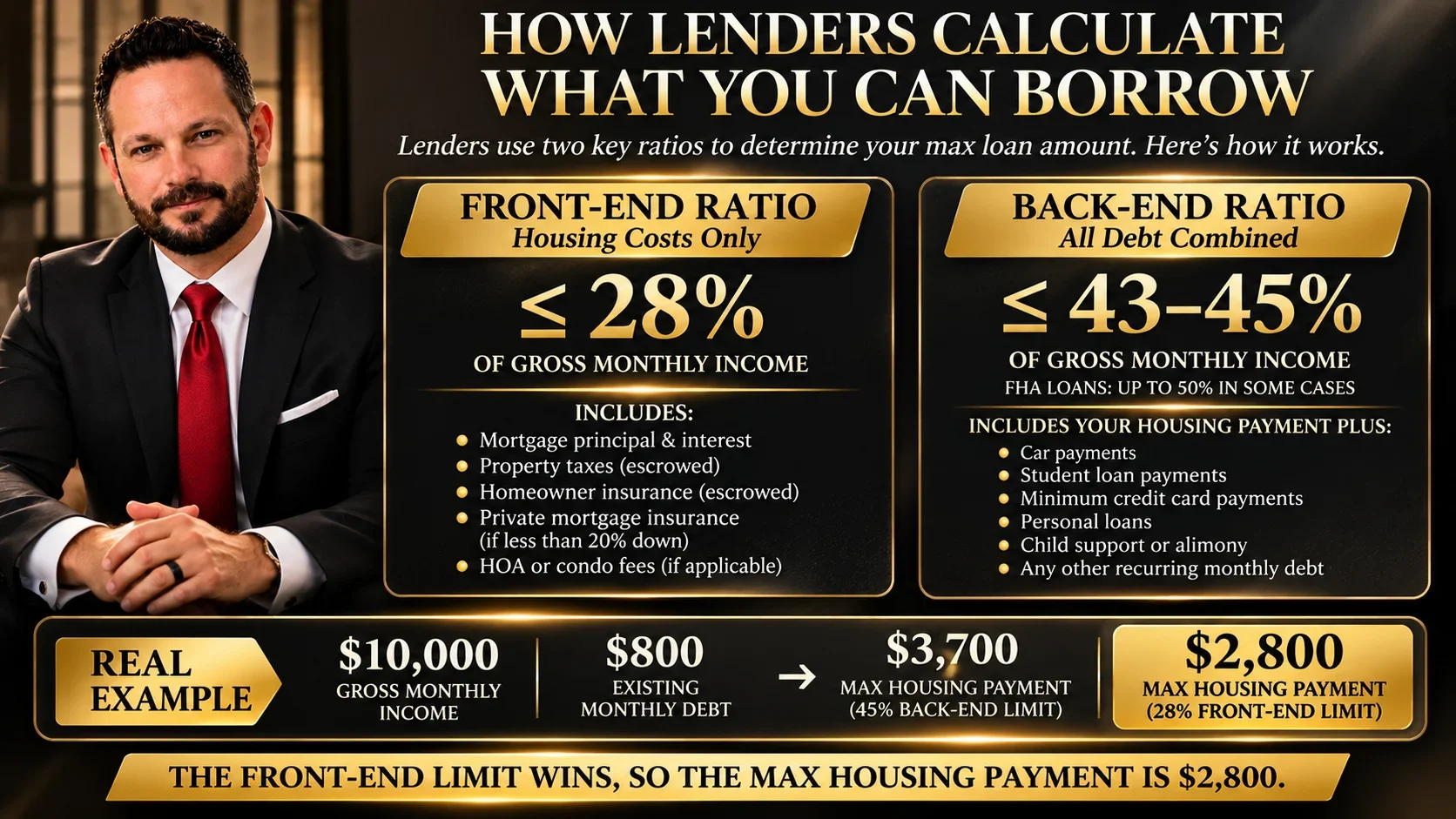
How Lenders Calculate What You Can Borrow
Mortgage lenders use two ratios to determine how much they will lend you. Understanding both is the starting point for any honest affordability conversation.
Front-End Ratio — Housing Costs Only
The front-end ratio measures your proposed monthly housing payment as a percentage of your gross monthly income. Most conventional lenders want this at or below 28 percent.
Your monthly housing payment includes:
Mortgage principal and interest
Property taxes (escrowed monthly)
Homeowner insurance (escrowed monthly)
Private mortgage insurance if your down payment is below 20 percent
HOA or condo fees if applicable
Example: a household earning $10,000 gross per month has a maximum front-end payment of $2,800 under the 28 percent guideline.
Back-End Ratio — All Debt Combined
The back-end ratio measures all monthly debt obligations — including your proposed housing payment — as a percentage of gross monthly income. Most conventional lenders cap this at 43 to 45 percent. FHA loans allow up to 50 percent in some cases.
Debts that count in your back-end DTI:
Car payments
Student loan payments
Minimum credit card payments
Personal loans
Child support or alimony obligations
Any other recurring debt with a payment
Example: the same household with $10,000 gross monthly income and $800 in existing monthly debt payments has a maximum housing payment of $3,700 under a 45 percent back-end limit — but only $2,800 under the front-end limit. The front-end limit wins.
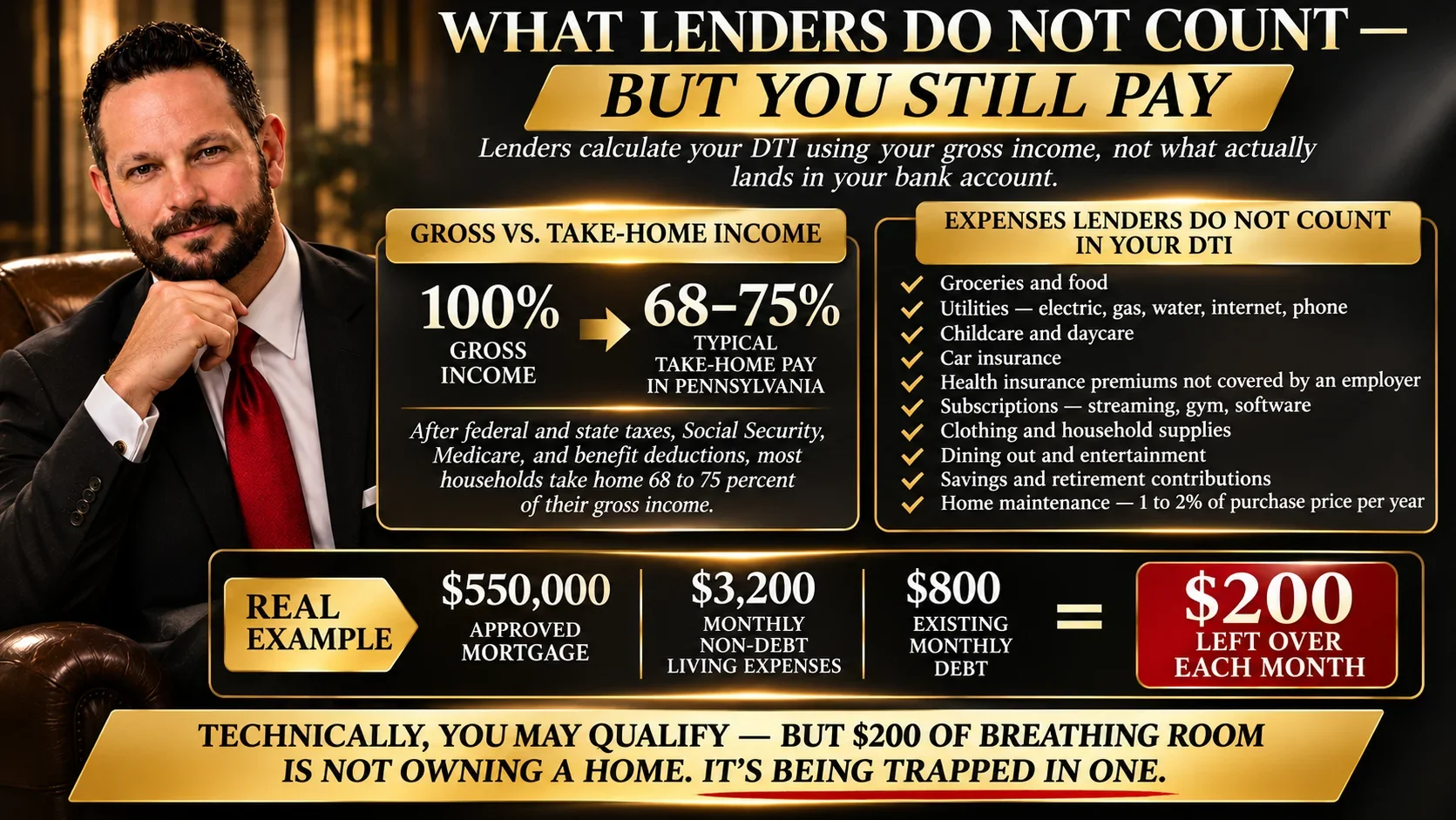
What Lenders Do Not Count — But You Still Pay
This is where the math breaks down for most buyers. Lenders calculate your DTI against your gross income. Your gross income is not what lands in your bank account. After federal and state taxes, Social Security, Medicare, and any benefits deductions, most households in Pennsylvania take home 68 to 75 percent of their gross income.
Beyond the tax gap, lenders do not count any of the following in their DTI calculation:
Groceries and food
Utilities — electric, gas, water, internet, phone
Childcare and daycare
Car insurance
Health insurance premiums not covered by an employer
Subscriptions — streaming, gym, software
Clothing and household supplies
Dining out and entertainment
Savings and retirement contributions
Home maintenance — the realistic number is 1 to 2 percent of purchase price per year
A buyer approved for a $550,000 mortgage who has $3,200 in monthly non-debt living expenses and $800 in existing debt may technically qualify — and may find themselves with $200 of breathing room after every monthly obligation is paid. That is not owning a home. That is being trapped in one.
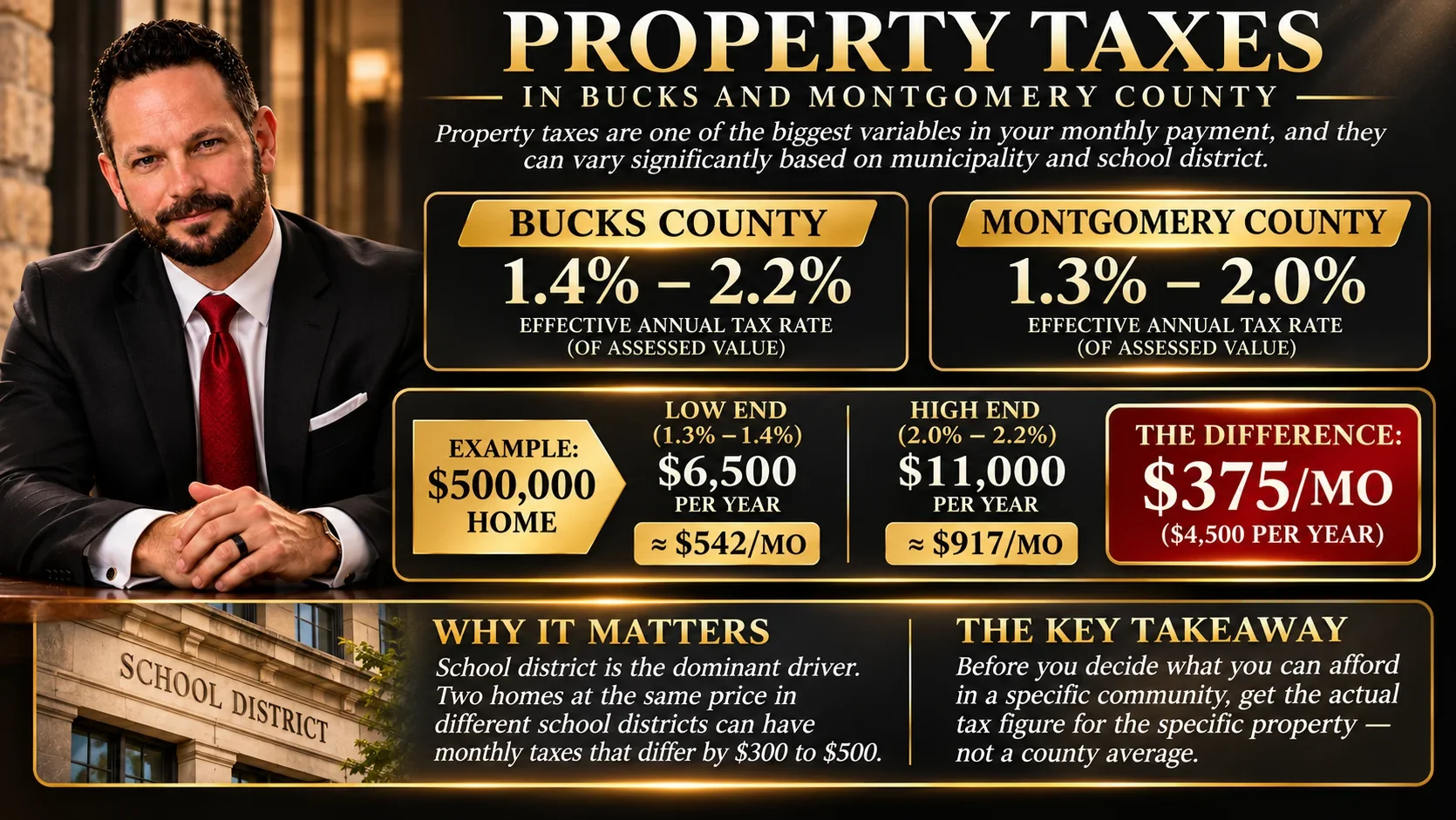
Property Taxes in Bucks and Montgomery County
Property taxes are the variable most buyers underestimate when calculating affordability in Bucks and Montgomery County. Unlike the mortgage payment, taxes vary dramatically based on municipality and school district — not just purchase price.
Effective annual tax rates in this region typically run:
Bucks County: 1.4 to 2.2 percent of assessed value annually
Montgomery County: 1.3 to 2.0 percent of assessed value annually
On a $500,000 home, that range means annual taxes of $6,500 to $11,000 — a difference of $375 per month between the low and high end. School district is the dominant driver. Two homes at the same price point in different school districts within the same county can carry monthly tax escrow payments that differ by $300 to $500.
Before you decide what you can afford in a specific community, get the actual tax figure for the specific property — not a county average. Your lender will escrow based on the actual tax bill.
Homeowner Insurance
Homeowner insurance in Bucks and Montgomery County typically runs $1,200 to $2,400 per year for a standard single-family home, depending on purchase price, construction type, age of the home, and coverage level. That is $100 to $200 per month added to your housing payment through escrow. Older homes, homes with oil tanks, and homes with outdated electrical or plumbing systems often carry higher premiums or require updates before a standard policy is issued.
Private Mortgage Insurance
If your down payment is below 20 percent, your lender requires private mortgage insurance. PMI rates typically run 0.5 to 1.5 percent of the loan amount annually, depending on your credit score and loan-to-value ratio.
On a $450,000 purchase with 10 percent down — a $405,000 loan — PMI at 0.75 percent adds $253 per month to your housing payment. PMI is removed once you reach 20 percent equity, either through payments, appreciation, or a combination. Until then, it is a real monthly cost that belongs in your affordability calculation.
Maintenance — The Cost Nobody Budgets
A house needs money every year. Roofs, HVAC systems, water heaters, windows, driveways, landscaping, appliances — none of these last forever, and none of them announce themselves at convenient times. The standard rule is to budget 1 to 2 percent of your purchase price per year for maintenance and repairs.
On a $450,000 home, that is $4,500 to $9,000 per year — $375 to $750 per month — that you need available, not necessarily spent every month but available when the furnace goes or the roof needs attention. Buyers who stretch to their purchase limit have no room for this. Buyers who buy at 85 to 90 percent of their maximum qualification do.
The Right Number Is Not Your Maximum Qualification
Lenders approve you for the most they can lend you, not the most you should borrow. Those are fundamentally different calculations. Your lender does not know what you spend on childcare. They do not know you are carrying $600 a month in subscriptions and car insurance. They do not know you contribute aggressively to a 401k. All of that comes out of your take-home pay after the mortgage is deducted.
The buyers who feel good about their purchase two years in are the ones who bought at a number where the monthly payment is manageable, the emergency fund survived the closing, and the first major repair did not require a personal loan. That is not about being conservative. It is about buying a home instead of buying a problem.
Use the calculator below to work through your real numbers. Then call Josh Wernick at 267-934-5674 to talk about what is available in Bucks and Montgomery County at the range that actually makes sense for your situation.
Can I Afford to Buy A House in Pennsylvania? - Frequently Asked Questions
How much house can I afford in Pennsylvania?
The standard lender guideline is that your total monthly housing payment should not exceed 28 percent of your gross monthly income, and your total monthly debt including housing should not exceed 43 to 45 percent. In Bucks and Montgomery County, where median prices run from the mid $400,000s to above $700,000, a household earning $120,000 per year can typically qualify in the $400,000 to $500,000 range with a 10 to 20 percent down payment and manageable existing debt. Use the calculator above to work through your specific numbers.
What is the debt-to-income ratio for a mortgage in Pennsylvania?
Most conventional lenders use a maximum back-end DTI of 43 to 45 percent. FHA loans allow up to 50 percent in some cases. The front-end ratio covering only housing costs should stay at or below 28 percent. Your credit score and down payment affect whether lenders grant exceptions to these limits.
How much do property taxes add to my monthly payment in Bucks or Montgomery County?
Effective tax rates in this region typically run 1.3 to 2.2 percent annually depending on municipality and school district. On a $500,000 home, annual taxes can range from $6,500 to $11,000 — a difference of $375 per month between the low and high end. School district is the dominant driver. Get the actual tax figure for each specific property before deciding what you can afford.
Why do buyers end up house poor in Bucks and Montgomery County?
The most common reason is buying at the top of what a lender will approve without accounting for actual monthly expenses. Lenders calculate DTI against gross income and exclude groceries, childcare, utilities, subscriptions, car insurance, and home maintenance. Buyers who buy at 85 to 90 percent of their maximum qualification retain margin for repairs, savings, and life. Buyers who stretch to their limit do not.
What down payment do I need to buy a house in Pennsylvania?
Conventional loans require 3 to 20 percent down. Down payments below 20 percent require PMI. FHA loans require 3.5 percent with a 580 credit score. VA loans require no down payment for eligible veterans. PHFA offers down payment assistance for qualifying first-time buyers in Pennsylvania. The minimum affects both your loan amount and your monthly PMI obligation.