

My Commercial Listing Expired in Bucks County PA
Your property sat on the market, the listing expired, and it did not sell. That is not a property problem. In most cases, it is an agent problem. Here is an honest diagnosis of why commercial listings fail in Bucks County — and what changes the second time around.

Frequently Asked Questions - What to Do When Your Commercial Listing Expires in Bucks County
Why did my commercial property not sell in Bucks County?
The most common reasons commercial listings expire in Bucks County without selling: the property was priced using residential comparable sales instead of commercial valuation methods (cap rate, replacement cost, income approach); the listing agent had no active commercial buyer network and relied entirely on passive portal exposure; the buyer pool for the specific asset type was never correctly identified or directly contacted; zoning was not verified for the most likely buyers before the listing went live, causing deals to collapse in due diligence; or the property was listed with a residential-focused agent who lacked commercial transaction experience. Each of these is a process failure, not a property defect.
Can I relist my commercial property after the listing expires?
Yes. After a listing agreement expires you are free to relist with any agent or broker. There is no mandatory waiting period under Pennsylvania law. The more important question is not whether you can relist but what changes before you do. Relisting with the same price, the same marketing approach, and the same agent produces the same result. A correctly diagnosed expired listing requires a revised pricing analysis, a clear identification of the actual buyer pool for that property type and location, and an agent with direct access to that buyer pool.
How is commercial property priced differently from residential in Bucks County?
Commercial property is priced primarily on income approach (capitalization rate applied to net operating income), replacement cost, and comparable commercial sales — not bedroom count, square footage of living space, or school district. An investment property is valued on what it produces. An owner-user property is valued on replacement cost and comparable sales of similar commercial buildings. A residential agent who prices a commercial building on residential market data will almost always misprice it, which either kills the listing from overpricing or leaves money on the table from underpricing.
What is the buyer pool for commercial property in Bucks County?
The buyer pool varies dramatically by asset type and location. A Lower Bucks industrial building attracts institutional and regional investors, logistics and distribution users, and owner-operators from the Philadelphia metro — buyers who read CoStar and LoopNet daily and are actively sourcing inventory. A Doylestown Borough storefront attracts local business owners, restaurateurs, and small investors who know that specific market. An upper Bucks rural commercial property has a narrow and highly specific buyer pool. Marketing a Bensalem warehouse the same way you market a Newtown office condo is a fundamental mismatch that keeps properties sitting unsold.
How long does it take to sell a commercial property in Bucks County?
BRIGHT MLS data shows 97 commercial transactions closed in Bucks County through 2026, with a median sale price of $575,000. Commercial transactions typically take 60 to 120 days from accepted offer to closing due to commercial due diligence timelines, lender requirements, and zoning verification. The listing period before an accepted offer varies widely by asset type — well-priced Lower Bucks industrial moves quickly given 6.5% vacancy and active institutional buyer demand; suburban office in a soft market requires more targeted marketing. Properties that expired once typically sell faster the second time when the pricing and buyer identification are corrected.
Should I lower the price after my commercial listing expires?
Not necessarily, and not before understanding why the listing failed. If the property received showings but no offers, pricing may be close but the buyer pool targeting was wrong. If the property received no showings at all, pricing is likely the issue. If the property received offers that fell through in due diligence, the problem is likely zoning, environmental history, or lease structure — none of which a price reduction fixes. A correct diagnosis comes before a price decision.
Who should I call when my commercial listing expires in Bucks County PA?
Josh Wernick is a licensed REALTOR at Keller Williams serving commercial sellers across all 54 Bucks County municipalities. License RS379021. Luxury Homes Certified through the Residential Real Estate Council. Josh has studied the Bucks County commercial market for years, including before entering real estate as a small business owner, and brings direct knowledge of the buyer pools, zoning complexity, and commercial valuation methods specific to this market. Same-day response guaranteed. Contact: 267-934-5674 or joshwernick@kw.com.
Bucks County Commercial Market — 2026
What the Market Actually Looks Like Right Now
97 commercial properties closed in Bucks County through 2026. The market is active. Properties are selling. When a commercial listing expires without a sale, the market is almost never the explanation.

Source: BRIGHT MLS 2026 YTD through November; Cushman & Wakefield Philadelphia Industrial MarketBeat Q3 2026.
Lower Bucks industrial is running 6.5% vacancy with 1.1 million square feet of positive absorption through Q3 2026 — a supply-constrained market with active institutional buyers. Doylestown accounted for 16 closed sales and $23.76 million in volume. The market is not the problem. Something specific to the listing is.
Expired & Canceled Commercial Listings — Bucks County 2026
82 commercial listings expired or were canceled in Bucks County without closing — $103.7M in combined asking price that did not transact. These sellers have already been through the market. Most will relist. The ones who change agents and change approach are the ones who close.

Top Markets for Expired Listings
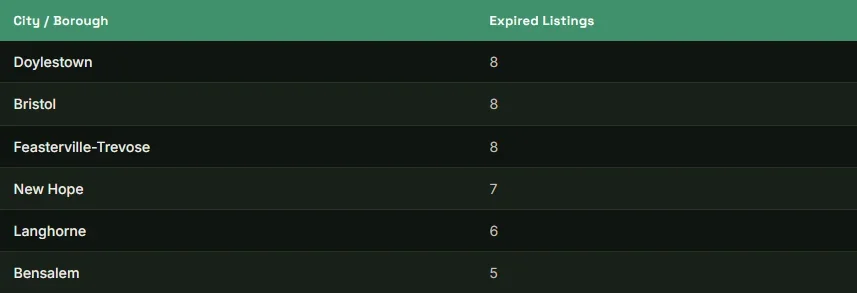
Source: BRIGHT MLS expired and canceled listing data, 2026. Excludes Levittown and Fairless Hills.
The Diagnosis
Why Commercial Listings Expire in Bucks County Without Selling
These are not abstract possibilities. They are the specific, recurring failure modes that account for the majority of expired commercial listings in this market.
Residential agent, commercial listing. A residential agent took the listing because they needed the commission. They had no commercial buyer network, no access to the institutional investors actively sourcing in this market, and no experience pricing on cap rate or income approach. The listing sat on MLS next to houses. The right buyers never saw it. (Seeing this one a lot lately) Commercial is not the same as residential. Call a commercial real estate agent - 267-934-5674
Priced on the wrong methodology. Commercial property is priced on income, replacement cost, and commercial comparable sales — not square footage of living space or bedroom count. A property priced using residential market data is almost always wrong. Overpricing kills showings. Underpricing kills the deal when buyers wonder what is wrong with it. (See biggest mistakes these residential agents are making)
Wrong buyer pool, wrong marketing. A Lower Bucks industrial building and a Doylestown Borough storefront have completely different buyer pools. If the marketing did not reach the specific buyers who actually acquire that asset type in that location, the listing was invisible to its most likely buyers regardless of how it was priced.
Zoning not verified before listing. Bucks County has 54 municipalities, 54 zoning ordinances. A buyer who wants to operate a specific use at the property needs to know that use is permitted before they commit. If zoning was not verified and disclosed upfront, deals collapse in due diligence — sometimes after the buyer has already spent money on inspections and attorneys. That kills the transaction and often the listing momentum.
Large broker, minimum deal size. An institutional commercial brokerage took the listing because the owner called them. The property fell below their minimum transaction size. It was assigned to a junior agent or handled passively. No proactive outreach, no direct buyer contact — just a portal listing and a quarterly check-in call. (Do you feel like your agent didn’t do enough? - Call me 267-934-5674
Environmental or structural issue not addressed proactively. A property with industrial use history, auto service, dry cleaning, or printing history has a Phase I ESA question hanging over it. If that was not addressed before listing, every serious buyer stalled at the same point in due diligence. The fix is a Phase I before listing, not after the third deal falls apart. Forever chemicals tend to make deals much harder.
Lease structure killed financing. An investment property with a below-market lease, a short remaining term, or an unfavorable tenant makes lender underwriting difficult. A buyer who cannot get financed cannot close. If the lease structure was not addressed before listing, it became the reason every offer fell apart.
Throw it on the MLS and pray is over. 90% of agents have never had to sell a property of any class in a buyer’s market. Skill wins in this market. 2026 has already seen a mass exodus of agents from the industry. It’s not as easy as throw a lockbox on the door and let them schedule their showing. Now you have to actually sell the property. 267-934-5674 let’s get yours sold!
The Second Listing
What Changes the Second Time Around
Relisting without changing the approach produces the same result. Here is what a correctly run second listing looks like.
Diagnosis before price. Before any number goes on a new listing, the question is why the first listing failed. Showings but no offers means one problem. No showings means a different problem. Offers that fell through in due diligence means a third problem. The diagnosis determines the fix.
Commercial valuation methodology. Cap rate analysis on the net operating income. Replacement cost evaluation. Comparable commercial sales — actual closed commercial transactions in Bucks County, not residential data. The price that attracts the right buyer is not necessarily lower than the expired listing price. Sometimes it is higher when the first agent underpriced on wrong methodology.
Buyer pool identification before launch. Who specifically buys this type of property in this location? Institutional industrial investors? Local owner-operators? Out-of-county 1031 exchange buyers? Private mixed-use investors? Each of those pools requires different outreach. The marketing strategy follows the buyer identification, not the reverse.
Zoning verified and documented upfront. Every buyer gets a clear picture of what is permitted by-right, what requires conditional use, and what the timeline looks like for any variance situation. Zoning surprises in due diligence are eliminated before the listing goes live.
Environmental history disclosed and addressed. If the property has any history that raises Phase I questions, the Phase I happens before listing. Buyers can proceed with confidence. Due diligence moves faster. Deals close.
Direct outreach to the actual buyer pool. Not just portal listings. Direct contact with the investors, owner-operators, and brokers who actively acquire this asset type in this corridor. The right buyer for a Bensalem industrial building is not found by waiting for LoopNet inquiries — they are identified and contacted directly.
The decision to sell is behind you. The question is not whether to relist — it is what is different this time. That conversation starts with an honest assessment of what the first listing got wrong, which requires someone willing to tell you the truth about it.
Why Josh Wernick
What Is Different About Working With Me
I am not going to tell you a number designed to get the listing. I will tell you what the market says your property is worth, who the realistic buyers are, and what a correct marketing timeline looks like for your specific property type and location in Bucks County.
I have studied this market for years — including before I was a REALTOR®, as a small business owner who spent years trying to find, buy, and lease commercial space in Bucks County and found the process unnecessarily difficult. That experience is the reason I know what the process looks like from the other side of the table, and it is what makes me different from an agent who learned commercial real estate from a continuing education course.
I work across the full spectrum of Bucks County commercial — from a $250,000 Langhorne flex suite to a $4.75 million Doylestown Borough building. I know the buyer pools for each asset type, the zoning across all 54 municipalities at the level needed to give a real answer before a client commits to due diligence, and the commercial valuation methodology that produces a defensible price.
I answer the phone. I respond to emails the same day. If you contact me about an expired commercial listing in Bucks County, you will hear back within hours — not days, not after I check with my team.
★★★★★
“Josh is incredibly dedicated and hard working. I would highly recommend him to anyone looking to buy or sell.”
Erin W. — Google Review
★★★★★
“Highly recommend Josh Wernick! His communication is top-notch. Highly professional, super responsive, and kept us informed through every stage of buying property. Exceptional service!”
Mirza A. — Google Review
★★★★★
“The ONLY person to work with in commercial real estate!”
Rita’s of Quakertown — Google Review